The Human Skull: A Complete Guide to Anatomy, Bones, and Structure
The human skull is the bony framework of the head, made up of 22 bones that protect the brain, support the face, and give the head its shape. It divides into two parts: the cranium, which encloses the brain, and the facial skeleton, which forms the face and jaw. This guide covers the whole skull in depth: every bone, the sutures that join them, how the skull develops, what each part does, and how to tell a real skull from a replica. Whether you are a student, an artist, a collector, or simply curious, this is the complete picture.
What is the human skull?
The human skull is the skeleton of the head. It is the hard, bony structure that houses and protects the brain, holds the organs of sight, smell, hearing and taste, and provides the framework for the face. Anatomically, it sits at the top of the vertebral column and is the most complex bony structure in the body.
The skull does three main jobs. It protects the brain and sensory organs from injury. It supports the face and provides attachment points for the muscles that let you chew, speak, and show expression. And it houses the entrances to the respiratory and digestive tracts. Every feature of its shape serves one of these functions.
The scientific study of the skull is called craniology, and it forms a core part of anatomy, medicine, forensic science, and physical anthropology. The skull is also one of the most recognizable objects in human culture, but this guide focuses first on the science: what the skull is actually made of.
How many bones are in the human skull?
The human skull has 22 bones. These divide into two groups: 8 cranial bones that enclose and protect the brain, and 14 facial bones that form the face, jaw and nasal structure.
That is the standard count used in anatomy, and it is the answer to one of the most searched questions about the skull. A few points of clarification often come up:
- The 22 bones do not include the six tiny ossicles of the middle ear (three in each ear), which are counted separately.
- They do not include the hyoid bone, which sits in the neck and is not part of the skull.
- The lower jaw, the mandible, is the only bone of the skull that moves freely, and it is counted among the 14 facial bones.
So when you read that the skull has 22 bones, that is 8 cranial plus 14 facial. Some sources count 28 or 29 if they add the ear ossicles and hyoid, but the standard skull total is 22.
The two parts of the skull: cranium and facial skeleton
The skull divides into two functional regions, and understanding this split makes the rest of the anatomy simple.
The cranium (or neurocranium) is the domed upper and rear part that encloses the brain. It is built from 8 bones fused together into a rigid, protective case called the cranial vault, with a floor called the cranial base.
The facial skeleton (or viscerocranium) is the front-lower part that forms the face. It is built from 14 bones that shape the eye sockets, nasal cavity, cheeks, upper jaw, and the movable lower jaw.
| Region | Also called | Number of bones | Main role |
|---|---|---|---|
| Cranium | Neurocranium | 8 | Encloses and protects the brain |
| Facial skeleton | Viscerocranium | 14 | Forms the face and jaw |
Together these 22 bones make up the complete skull. The sections below name every one.
The 8 cranial bones
The cranium is made of eight bones that fuse together to form the protective case around the brain. Here is each one, with what it does.
- Frontal bone. Forms the forehead, the upper part of the eye sockets, and the front of the cranial floor. In the womb it begins as two halves, which usually fuse into one.
- Parietal bones (2). A pair that forms most of the top and sides of the skull. They meet at the midline along the sagittal suture.
- Temporal bones (2). A pair at the lower sides of the skull, around the ears. Each houses the structures of hearing and balance and bears the socket for the jaw joint.
- Occipital bone. Forms the back and base of the skull. It contains the foramen magnum, the large opening through which the spinal cord passes to join the brain.
- Sphenoid bone. A single, butterfly-shaped bone spanning the width of the cranial floor. It is often called the keystone of the skull because it joins with almost every other cranial bone.
- Ethmoid bone. A small, spongy bone between the eye sockets that forms part of the nasal cavity and the medial wall of the orbits.
Counting the paired bones, that is 8 cranial bones in total: the frontal, occipital, sphenoid and ethmoid singly, plus the paired parietal and temporal bones. Together they form the cranial vault, the domed roof, and the cranial base, the floor on which the brain sits.
The cranial vault and base
The cranium has two functional parts. The cranial vault (or calvaria) is the domed upper portion, the part removed as a “skull cap” in anatomical preparations. The cranial base is the floor of the skull, a complex surface with openings, called foramina, through which nerves and blood vessels pass. The largest of these is the foramen magnum in the occipital bone.
A closer look at the key cranial bones
A few cranial bones are worth understanding in more detail, because they do more than simply enclose the brain.
The sphenoid bone is the most complex bone in the skull. Sitting in the middle of the cranial base, it articulates with all seven other cranial bones and forms part of the orbits, the nasal cavity and the floor of the brain case. Its central hollow, the sella turcica, cradles the pituitary gland. Anatomists call it the keystone of the cranium for good reason.
The temporal bones are remarkable for how much they contain. Each houses the entire hearing apparatus and the organs of balance, and each carries the mandibular fossa, the socket for the jaw joint. The bony bump you can feel behind your ear is the mastoid process of the temporal bone, an important muscle attachment and a landmark used in forensics.
The occipital bone at the back and base is defined by the foramen magnum, the great opening through which the brainstem passes to become the spinal cord. On either side of it are the occipital condyles, the rockers that meet the first vertebra and let you nod your head.
The ethmoid bone, though small and light, is one of the most intricate. Sitting between the eyes at the roof of the nose, it forms part of the orbit and nasal cavity and carries the cribriform plate, a perforated shelf through which the nerves of smell pass from the nose to the brain.
The 14 facial bones
The facial skeleton is made of fourteen bones that shape the face, hold the teeth, and frame the eyes and nose. Here is each one.
- Maxillae (2). The paired upper jaw bones are fused at the midline. They hold the upper teeth and form the front of the hard palate, the floor of the nose and part of the eye sockets.
- Zygomatic bones (2). The cheekbones, which form the prominence of the cheek and part of the outer eye socket.
- Nasal bones (2). Two small bones forming the bridge of the nose.
- Lacrimal bones (2). Tiny, fragile bones in the inner eye socket, the smallest bones of the face.
- Palatine bones (2). L-shaped bones forming the back of the hard palate and part of the nasal cavity.
- Inferior nasal conchae (2). Thin, scroll-like bones inside the nasal cavity that increase its surface area.
- Vomer. A single, flat bone forming the lower part of the nasal septum, the divider between the nostrils.
- Mandible. The lower jaw is the only freely movable bone of the skull. It holds the lower teeth and forms the jaw joint with the temporal bones.
There are 14 facial bones: six pairs (maxillae, zygomatic, nasal, lacrimal, palatine, and inferior nasal conchae) plus two single bones (the vomer and the mandible).
| Facial bone | Number | Forms |
|---|---|---|
| Maxillae | 2 | Upper jaw, palate, nose floor |
| Zygomatic | 2 | Cheekbones |
| Nasal | 2 | Bridge of the nose |
| Lacrimal | 2 | Inner eye socket |
| Palatine | 2 | Back of hard palate |
| Inferior nasal conchae | 2 | Inside the nasal cavity |
| Vomer | 1 | Nasal septum |
| Mandible | 1 | Lower jaw (movable) |
Skull sutures: how the bones join
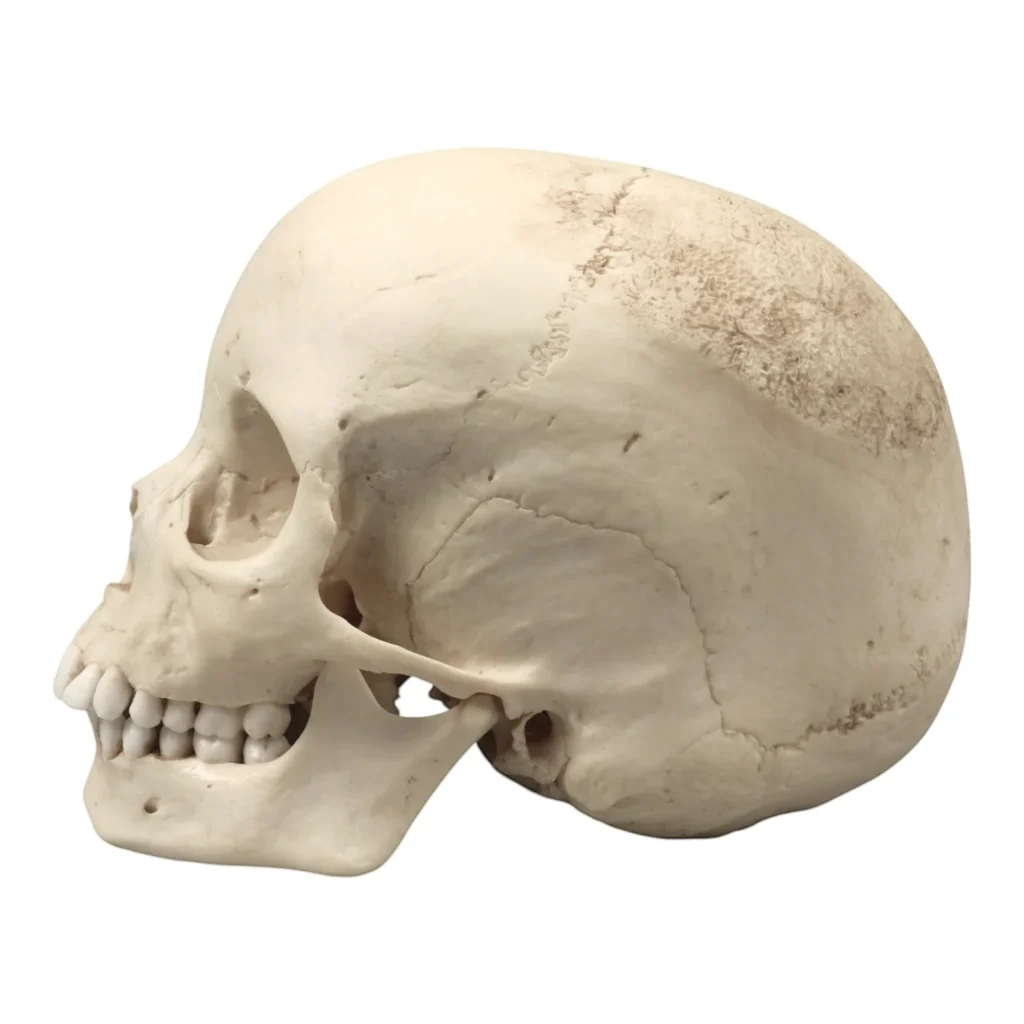
The bones of the skull are held together by sutures, immovable joints where the bones interlock like puzzle pieces. In adults these are fixed and rigid; in babies they are flexible, which matters for birth and growth. The main sutures are worth knowing because they are landmarks used throughout anatomy and forensics.
- Coronal suture. Runs across the top of the skull, joining the frontal bone to the two parietal bones.
- Sagittal suture. Runs front to back along the midline of the top of the skull, joining the two parietal bones.
- Lambdoid suture. Runs across the back of the skull, joining the parietal bones to the occipital bone.
- Squamous sutures. Run along the sides, joining the parietal bones to the temporal bones.
Where the coronal and sagittal sutures meet sits the bregma; where the sagittal and lambdoid sutures meet sits the lambda. These points begin life as the soft spots, or fontanelles, of a baby’s skull. The pattern of the sutures is also used by forensic scientists to help estimate age, since sutures fuse progressively over a lifetime.
The orbits, nasal cavity and other features
Beyond the individual bones, the skull has several important cavities and openings formed where bones meet.
The orbits are the two bony eye sockets, each formed by parts of seven different bones, that protect and house the eyes. The nasal cavity is the large central opening of the nose, divided by the septum and framed by several facial bones. The paranasal sinuses are air-filled spaces within the frontal, sphenoid, ethmoid, and maxillary bones that lighten the skull and affect the voice.
The skull is also pierced by many foramina, openings that let nerves and blood vessels pass through. The largest is the foramen magnum, where the spinal cord connects to the brain. These features are why the skull, despite its strength, is far lighter than a solid bone of the same size would be.
What does the human skull do?
The skull’s structure follows directly from its functions. Everything about its shape serves one of these purposes.
Protection. The cranium is a rigid case that shields the brain from impact, and the orbits protect the eyes. The skull is one of the strongest structures in the body relative to its weight, built to absorb and distribute force.
Support and shape. The facial skeleton gives the face its form and holds the teeth in the upper and lower jaws. It provides the framework that soft tissue, muscle, and skin are built upon, which is why the skull determines the basic shape of a face.
Movement and function. The mandible forms a hinge joint that lets you chew and speak. Dozens of muscles attach to the skull, powering chewing, swallowing, eye movement and the many muscles of facial expression.
Housing the senses. The skull holds four of the five senses: sight in the orbits, smell in the nasal cavity, hearing and balance in the temporal bones, and taste via the mouth it frames. This concentration of sensory organs in one protected structure is a defining feature of the head.
How the skull develops and grows
The skull is not fixed from birth; it changes dramatically over a lifetime. Understanding this development explains several features of the adult skull.
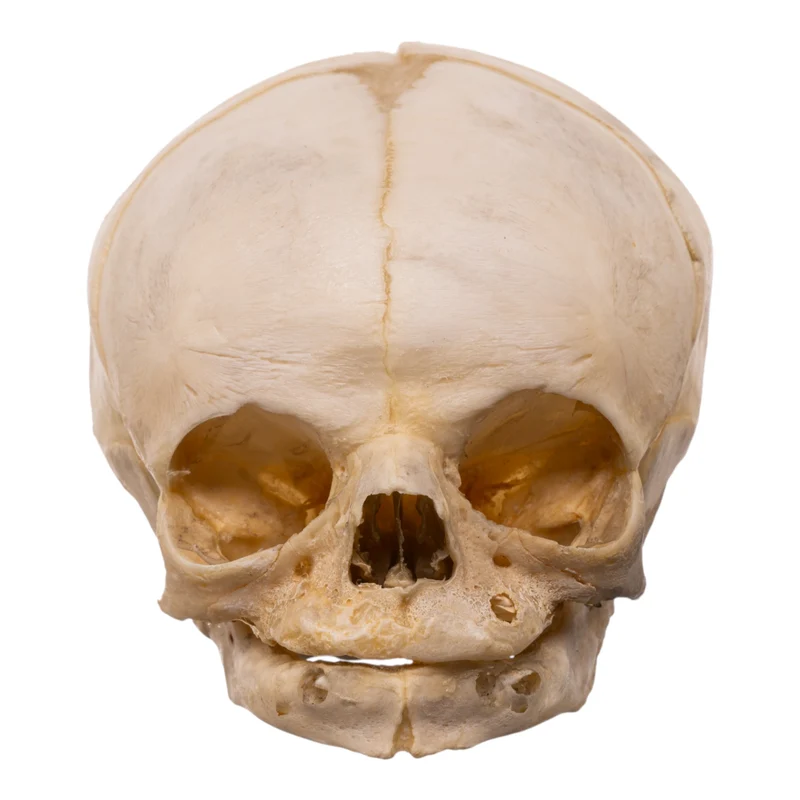
A newborn’s skull is not fully fused. It has soft spots called fontanelles, gaps of flexible tissue where the bones have not yet met. These allow the skull to flex during birth and to accommodate the rapid growth of the brain in infancy. The largest, the anterior fontanelle, is the familiar soft spot on top of a baby’s head, and it usually closes by around two years of age.
As a child grows, the fontanelles close and the skull bones knit together at the sutures. The frontal bone, which starts as two halves, usually fuses into one. The skull continues to change into adulthood, and the sutures gradually fuse over decades, a process forensic scientists use to help estimate age. The teeth also erupt in stages, from milk teeth to the adult set, which is another marker of age read from the skull.
Differences between skulls
No two skulls are identical, and several kinds of variation are studied in anatomy and forensic science.
Individual variation. Every person’s skull is slightly different in size, proportion, and features, which is part of what makes a real skull a unique object.
Age. A child’s skull has a proportionally larger cranium and smaller face than an adult’s, unfused sutures, and different teeth. As covered above, suture fusion and dental development are used to estimate age.
Sex. Forensic anthropologists can often estimate biological sex from a skull, using features such as the brow ridge, the size of the mastoid process, and the shape of the jaw and chin, though these are statistical tendencies rather than absolute rules.
Ancestry and population. Skulls vary across human populations in subtle, measurable ways, a field studied in physical anthropology. This is complex and often misunderstood, and modern anthropology treats it with great care.
These differences are exactly what make the skull so valuable for study, and why genuine specimens remain important for teaching anatomy, medicine and forensics.
How strong is the human skull?
The human skull is remarkably strong for its weight, which is one of the most searched questions about it. The cranium is engineered to protect the brain from impact, using a domed shape that distributes force, much as an arch or an eggshell does. It takes a substantial force to fracture an adult skull, and the rounded vault is designed to deflect and spread the load rather than absorb it at a single point.
That strength is not uniform. The skull is thicker and stronger at the back and base, and thinner at the temples, where the temporal bone is at its most delicate. This is why the temple is considered a vulnerable point. The skull also works together with the cerebrospinal fluid around the brain, which cushions it, and with the sutures, which in a young skull can flex slightly under load. For all its strength, the skull is not indestructible, which is why it remains the body’s priority to protect.
The human skull compared to other animals
Placing the human skull alongside other animals highlights what makes it distinctive, and it is why comparative collections are so valued in education. Compared with most mammals, the human skull has a very large, rounded braincase relative to the face, reflecting our large brain. The face is flat and tucked beneath the front of the cranium rather than projecting forward into a snout.
Human teeth are relatively small and even, without the large canines of many predators. The position of the foramen magnum, tucked underneath the skull rather than at the back, reflects our upright, two-legged posture, since the skull sits balanced on top of the spine. These features are exactly what students of comparative anatomy learn to read and why a human skull is often studied alongside primate and other mammal skulls. Our animal skulls guide explores the wider world of comparative osteology.
Real human skull vs replica: how to tell the difference
Because real and replica skulls are both widely used, it helps to know how they differ. This matters for students, collectors, and anyone buying a specimen.
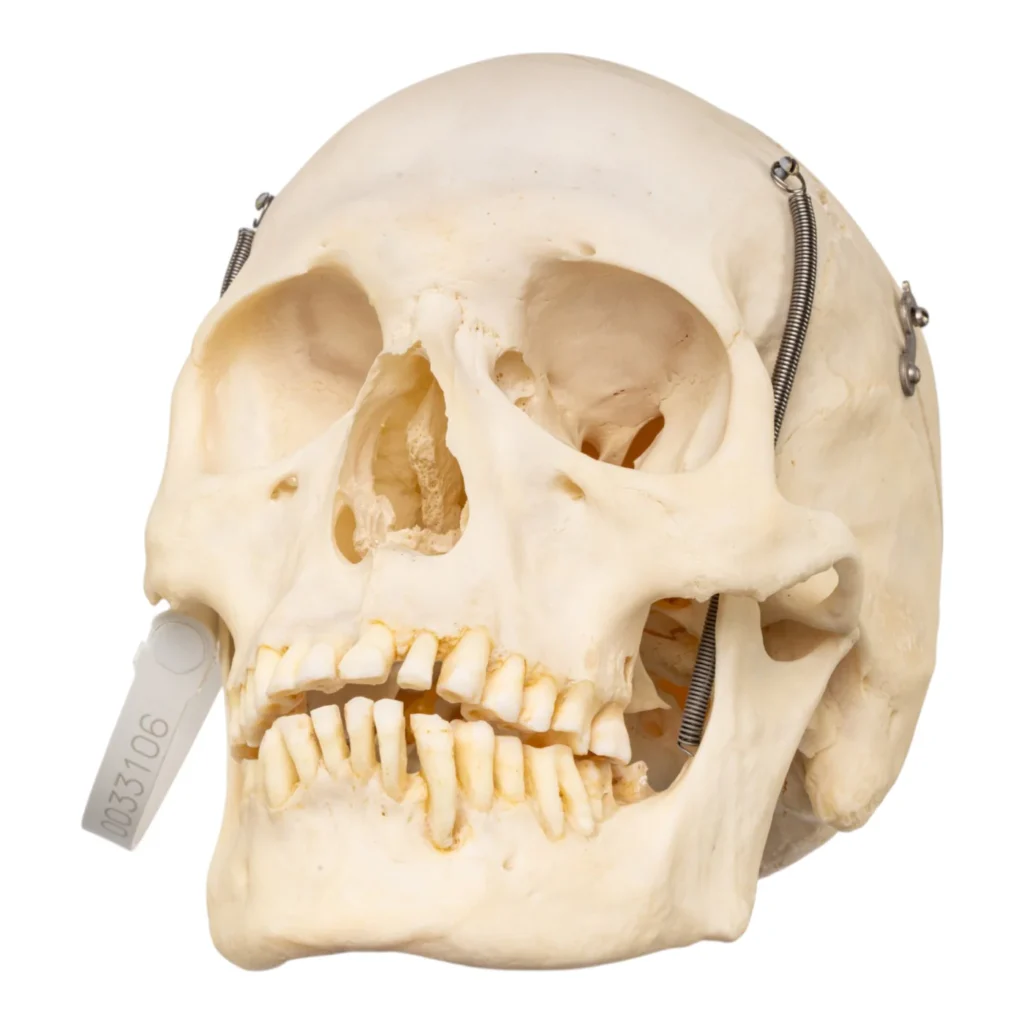
A real human skull is genuine bone. It shows natural colour and slight asymmetry, unique suture patterns, real teeth with natural wear, and often signs of its history as a teaching specimen, such as a cut calvarium (a removable skull cap) or brass hardware and hinges. Real bone is surprisingly light and cool to the touch.
A replica skull is a cast, usually resin or plastic. Good medical replicas are extremely accurate and are the standard choice for teaching because they are durable, legal everywhere, and affordable. A replica has a uniform color, identical sutures on every copy, and sometimes a faint mold seam.
| Feature | Real skull | Replica |
|---|---|---|
| Material | Genuine bone | Resin or plastic cast |
| Weight | Light, cool to touch | Often heavier or warmer |
| Sutures | Unique, three-dimensional | Identical on every copy |
| Teeth | Natural wear and variation | Uniform, molded |
| Color | Natural, slightly uneven | Uniform |
| Legality | Restricted in some places | Legal almost everywhere |
For a full breakdown, see our guide on how to tell a real human skull from a replica.
Products by Category
-
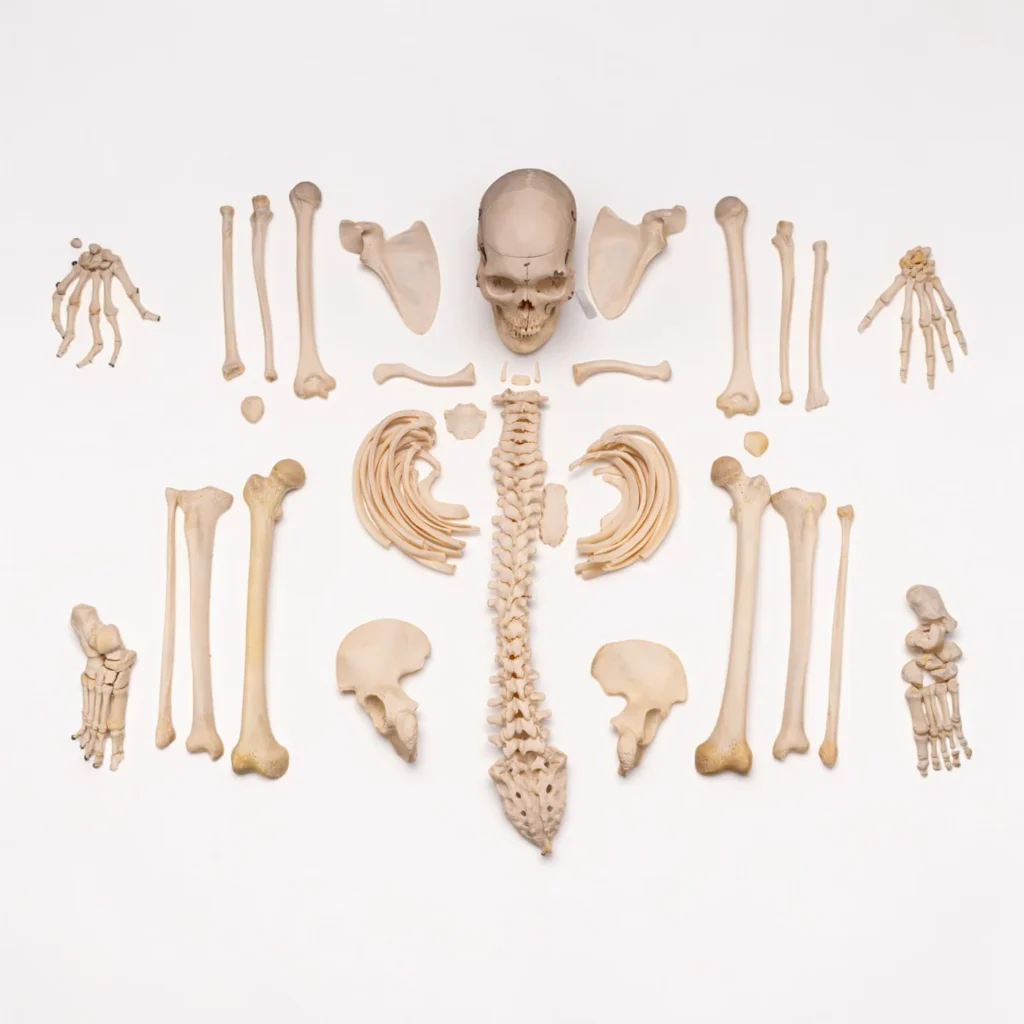
Disarticulated Real Human Skeleton
-
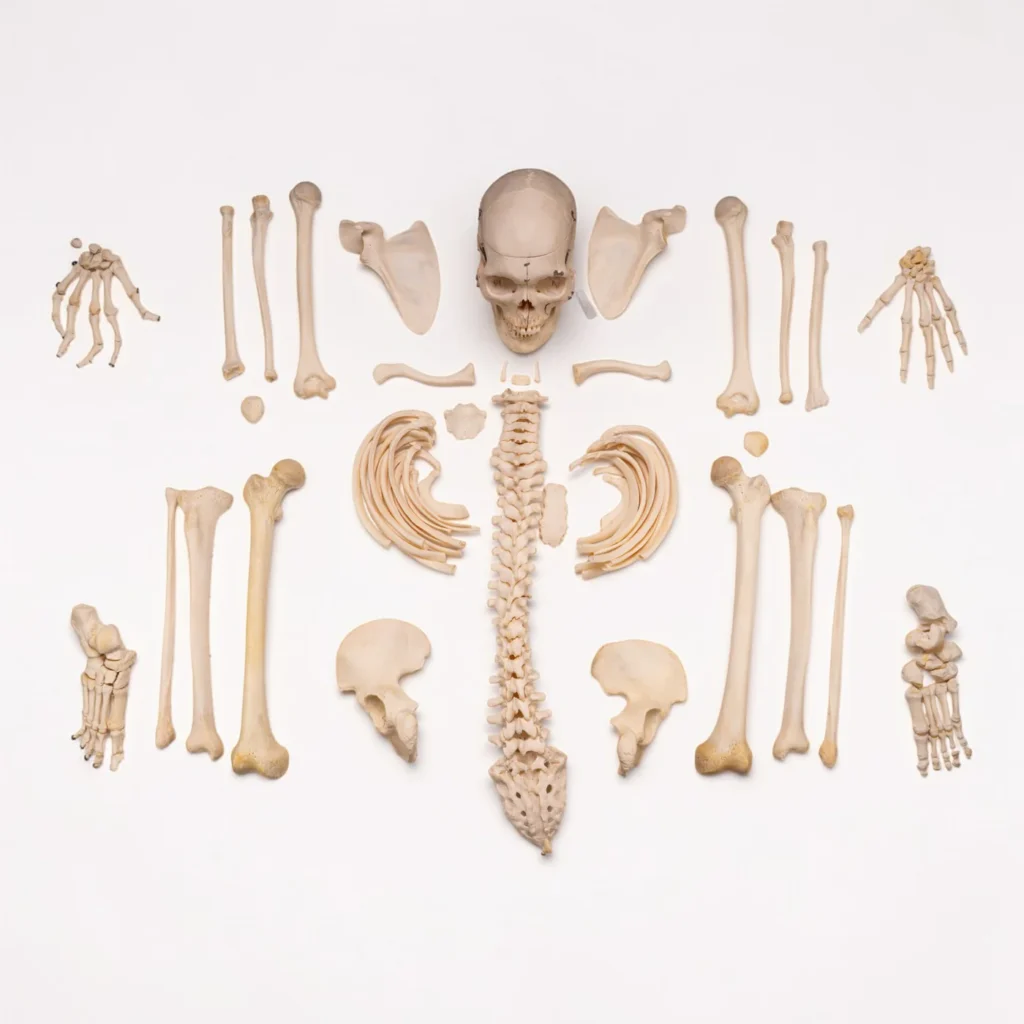
Half Real Human Skeleton
-
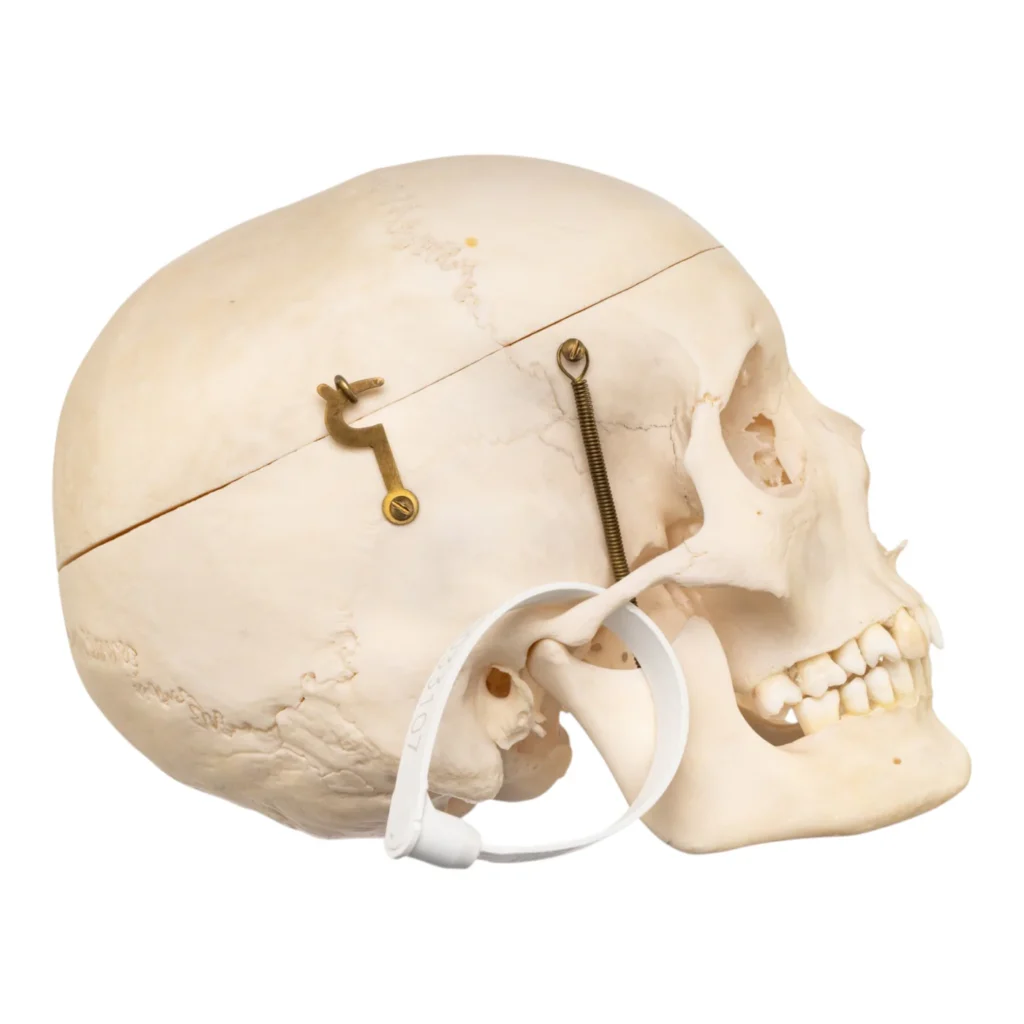
Human Skull for Sale – Real Medical Specimen with Calvarium Cut
-
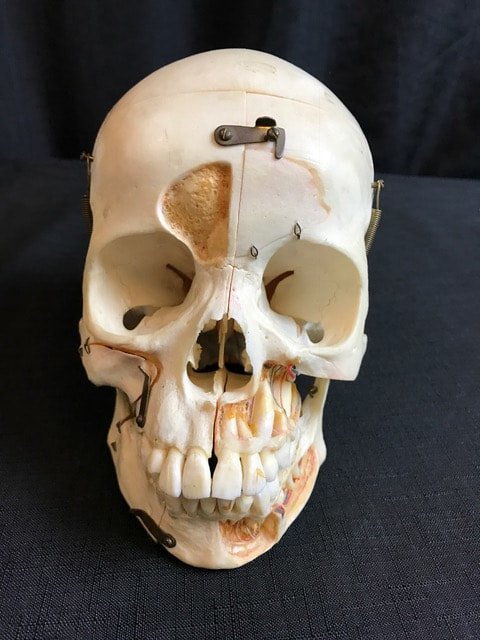
Male skull | India
-
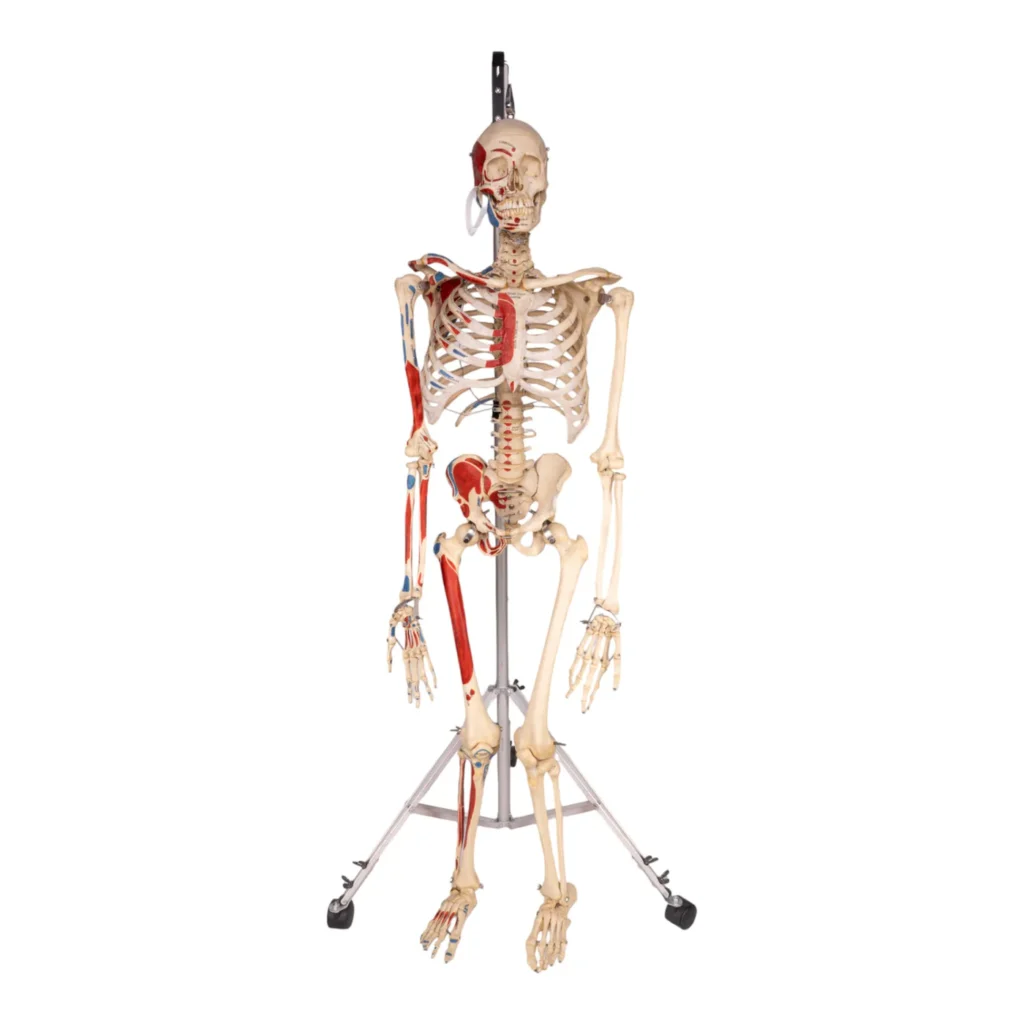
Painted Real Human Skeleton – Articulated
-
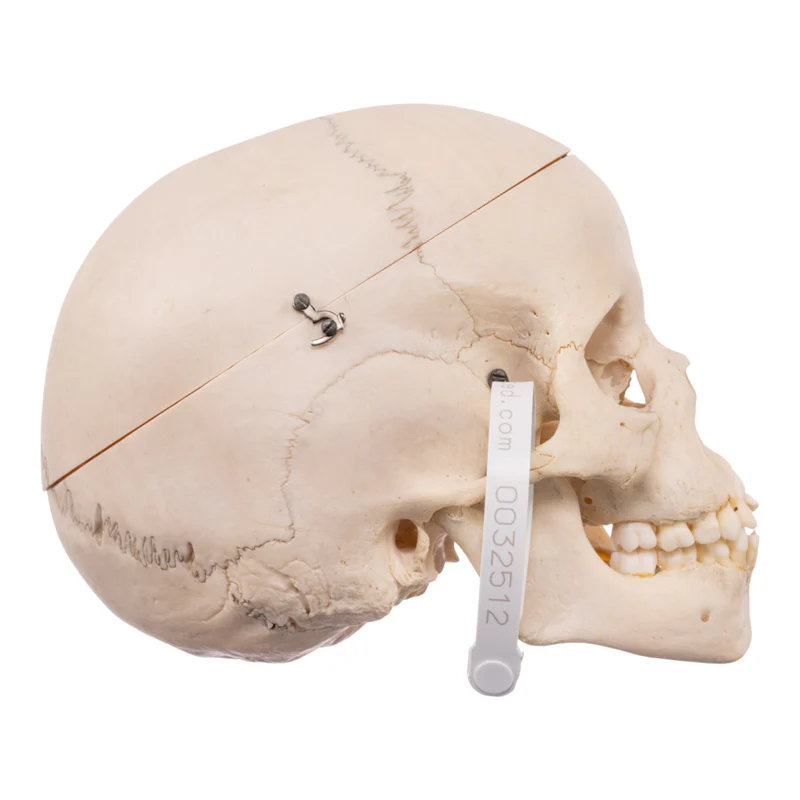
Real Child Human Skull With Case
-
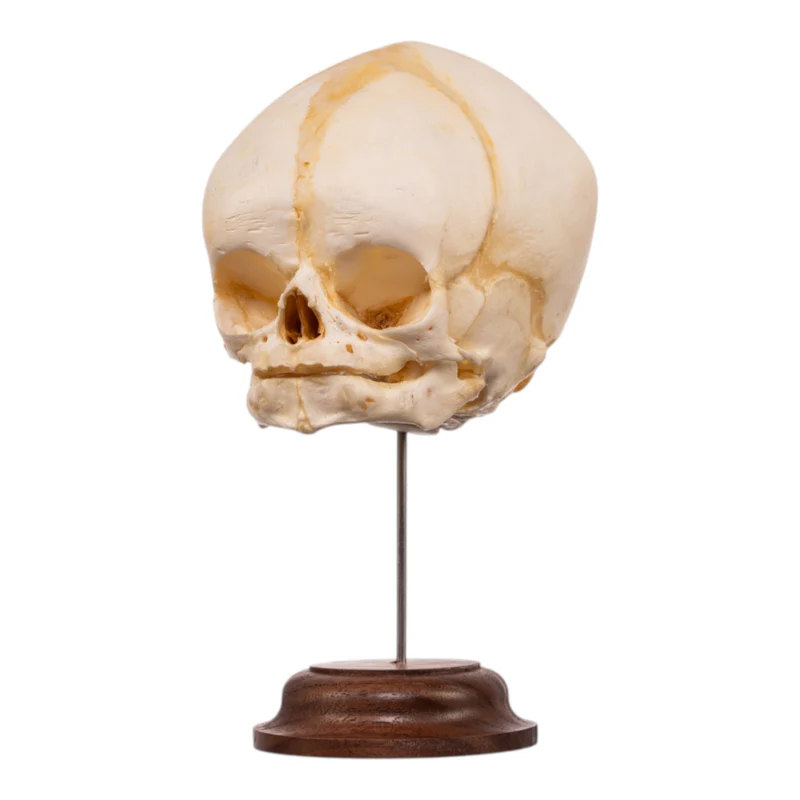
Real Fetal Human Skull on Stand
-
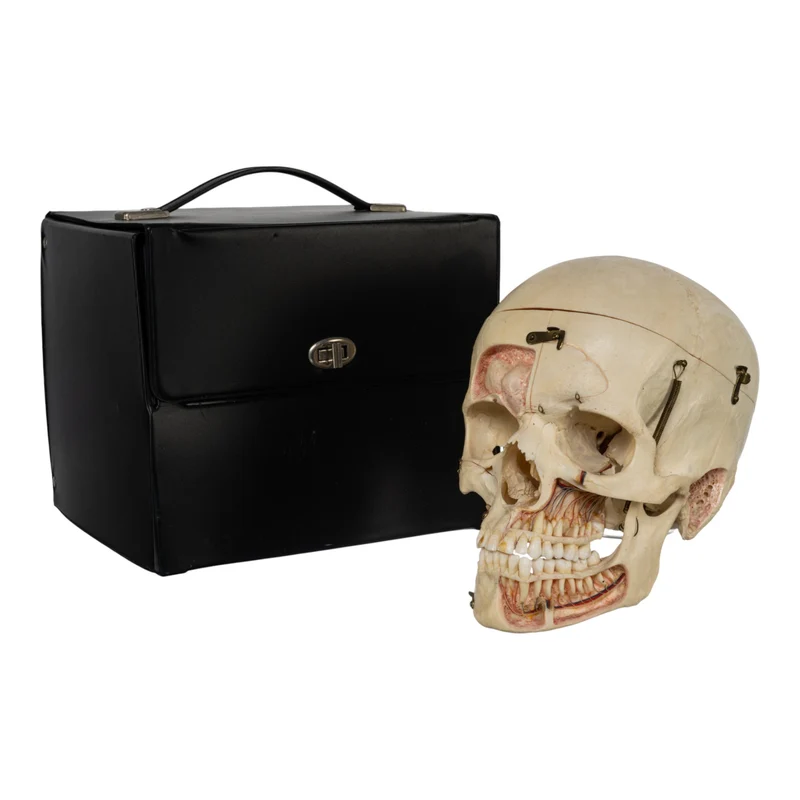
Real Human Dissected Skull in Case
-
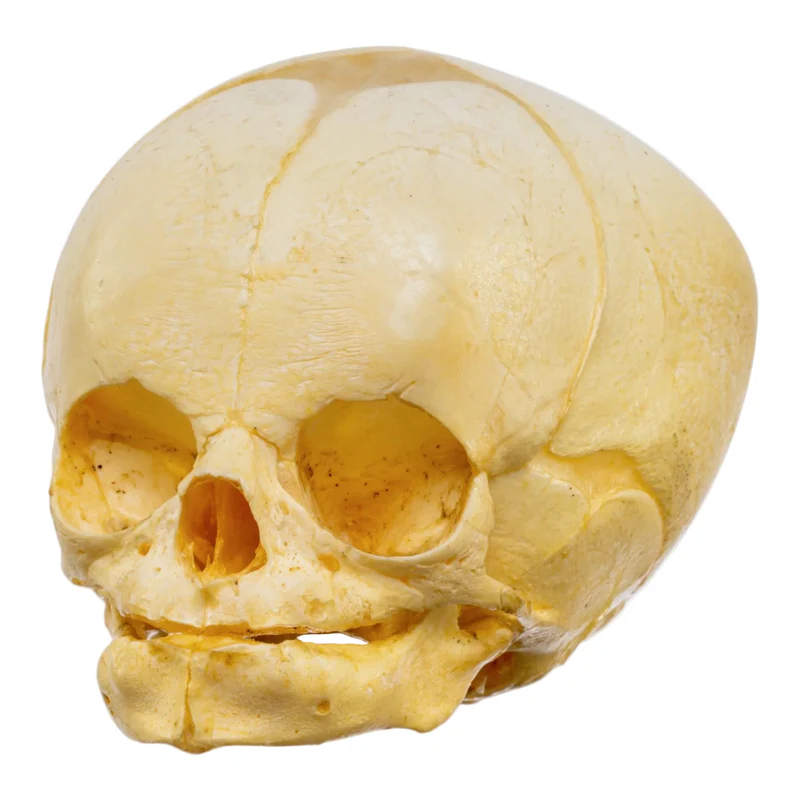
Real Human Fetal Skull
The human skull in art and culture
Beyond its anatomy, the human skull is one of the most powerful symbols in human culture, and this is part of why it fascinates so many people. For centuries artists have used the skull as a memento mori, a reminder of mortality, in paintings, sculpture, and jewelry. It appears in the still-life tradition, in religious art, and in the vanitas paintings of the Dutch Golden Age.
The skull carries many meanings across cultures: mortality and the passage of time, but also protection, rebirth, and celebration, as in the decorated skulls of the Mexican Day of the Dead. It is a staple of tattoo art, fashion, and design, and it remains a favorite subject for artists learning to draw the human form, since the skull underlies the shape of every face. This cultural richness is a subject in its own right, explored in our guide to skull symbolism and meaning. Here, though, the focus remains the physical object: the real bone that all this symbolism is built upon.
Who studies and collects human skulls?
The human skull has been studied and collected for centuries, and today its owners fall into a few clear groups. Medical and dental students learn anatomy from skulls. Physicians, surgeons, and forensic scientists use them for reference and training. Artists study the skull to understand the structure beneath the face. Anthropologists and researchers examine variation across populations. And private collectors value skulls as objects of science, history and natural beauty.
This is a long and legitimate tradition. For most of medical history, students learned from real bone, and a large industry supplied prepared skulls to schools worldwide. That history, and how genuine specimens reach the market today, is covered in our guide to the history of the medical bone trade.
Is it legal to own a human skull?
In most countries, yes, it is legal to own a lawfully obtained human skull, though the rules vary and some places restrict sale or possession. There is no federal ban in the United States, though Native American remains are protected under NAGPRA, and a few states restrict sales, with Louisiana, Georgia, and Tennessee the most consistently cited. In the UK, private ownership is generally lawful, with restrictions on the public display of remains under 100 years old.
Because the law depends on where you live and where a specimen came from, always confirm your local rules before buying. We cover this fully in our guide on whether it is legal to own a human skull, and reputable dealers confirm they can lawfully ship to you before any sale.
Buying a real or replica human skull
If you want a skull for study, art, or collecting, you have two good options. A genuine specimen offers the authenticity and detail that serious study and collecting demand. A high-quality replica offers accuracy, durability, and legality at a lower price and is ideal for teaching or a first piece.
Whichever you choose, buy from a specialist who documents provenance and confirms legality, not an anonymous marketplace listing. Browse our curated collection of real and replica human skulls, each responsibly sourced and documented. For guidance, see our human skull buyer’s guide.
Frequently asked questions
How many bones are in the human skull?
The human skull has 22 bones: 8 cranial bones that protect the brain and 14 facial bones that form the face and jaw. This does not include the six middle-ear ossicles or the hyoid bone, which are counted separately.
What are the 8 cranial bones?
The frontal bone, the occipital bone, the sphenoid bone, the ethmoid bone, and the paired parietal and temporal bones. Together they form the protective case around the brain.
What is the strongest bone in the skull?
The mandible, the lower jaw, is the strongest and hardest bone in the skull. The rest of the skull is also very strong for its weight, built to protect the brain.
Which is the only movable bone in the skull?
The mandible, or lower jaw, is the only bone of the skull that moves freely. It forms the jaw joint with the temporal bones and lets you chew and speak.
What is the difference between the cranium and the skull?
The skull is the whole bony structure of the head, all 22 bones. The cranium is the part that encloses the brain, made of 8 of those bones. The skull includes the cranium plus the 14 facial bones.
How thick is the human skull?
The thickness of the human skull varies by location, but on average it is roughly 6 to 7 millimeters, thicker in some regions and thinner in others. It is thickest at the back and base.
How much does a human skull weigh?
A dry adult human skull typically weighs around 1 to 1.5 kilograms without the mandible, though this varies with size and bone density.
What holds the skull bones together?
Immovable joints called sutures, where the bones interlock. The main ones are the coronal, sagittal, lambdoid, and squamous sutures. In babies these are flexible and include soft spots called fontanelles.
Is it legal to own a human skull?
In most countries, yes, for a lawfully obtained specimen. There is no federal ban in the United States, though a few states restrict sales, and some countries have their own rules. Always confirm your local law before buying.
Caring for a real human skull
A genuine skull is a durable but irreplaceable object, and basic care keeps it in good condition for generations. Keep it out of direct sunlight, which yellows and dries bone over time, and aim for stable, moderate humidity, since damp encourages mold and very dry air can cause cracking. Handle it by supporting the cranium rather than lifting by the delicate zygomatic arches, the teeth, or the nasal bones, which are the most fragile parts.
Dust a skull gently with a soft, dry brush. Never wash bone or use household cleaners, which stain and degrade it. If a specimen has a hinged calvarium or brass fittings, handle the hardware gently and check it occasionally. A display case protects a skull from dust, knocks and curious hands, and shows it to best effect. Treated this way, a real skull lasts indefinitely, which is why museum specimens survive in good condition for centuries.
Explore the human skull further
The human skull is the most complex and fascinating structure in the body, a case of engineering that protects the brain, frames the senses, and gives every face its shape. Whether you are studying its anatomy, drawing it, or collecting genuine specimens, understanding the skull deepens your appreciation of it. Browse our collection of real and replica human skulls, or explore our related guides on skull anatomy and collecting. Every specimen is responsibly sourced and ships worldwide in 3 to 5 days.