
Woolly Mammoth Tusks: The Complete Collector’s Guide
A woolly mammoth tusk is a genuine Ice Age fossil, the elongated ivory tooth of an extinct animal that lived tens of thousands of years ago. Because the woolly mammoth is extinct, its tusks are legal to own in most of the world, unlike elephant ivory. This guide covers everything you need to know before you buy: what a mammoth tusk is, how it fossilizes, the patina colors that drive value, how to spot a real specimen, the law, the price, and how to care for one. Read it once and you will buy with confidence.
What is a woolly mammoth tusk?
A woolly mammoth tusk is a giant, curved incisor tooth from the woolly mammoth (Mammuthus primigenius), the shaggy elephant relative that roamed Ice Age Europe, Asia, and North America. Tusks are not horns. They are teeth, made of dentine (the hard, ivory-forming tissue inside a tooth). That is why a mammoth tusk is described as fossil ivory.
Mammoths grew tusks throughout their lives. In large bulls, a single woolly mammoth tusk could reach twelve to fifteen feet along its curve. The tusks spiraled outward and often crossed at the tips, a shape the animals used for display, defense, and sweeping snow from winter grazing. No two tusks are identical. Each one records the growth, injuries, and habits of a single animal.
The woolly mammoth died out around four thousand years ago. Every mammoth tusk on the market today is therefore a true fossil, not a modern product. That single fact shapes everything about collecting them.
The woolly mammoth: a short natural history
The woolly mammoth ruled the Ice Age world, a cold-adapted giant built for a landscape that no longer exists. It lived across the mammoth steppe, a vast grassland that stretched from Western Europe through Siberia and into North America during the Pleistocene epoch.
A woolly mammoth stood up to eleven feet at the shoulder. It carried a thick coat of long hair, a layer of insulating fat, small ears to limit heat loss, and a high domed skull that stored fat and muscle. Its tusks were tools as much as weapons. Mammoths used them to fight, to display, and to clear snow from the grass they needed to survive the winter.
The species declined as the Ice Age ended. A warming climate shrank the mammoth steppe, and human hunting added pressure. Mainland populations vanished around ten thousand years ago. A final population survived on Wrangel Island in the Arctic Ocean until roughly four thousand years ago. When you hold a woolly mammoth fossil, you hold a piece of that lost world. This natural history is also why every woolly mammoth tusk, tooth, and bone is finite: no new ones are being made.
How woolly mammoth tusks fossilise
A woolly mammoth tusk becomes a fossil through slow burial and mineral change. When a mammoth died, its body sometimes came to rest in cold, wet ground. In the Arctic, that ground froze into permafrost, the permanently frozen soil that blankets much of Siberia and Alaska.
Locked in permafrost, a tusk can survive for tens of thousands of years. Over that time, groundwater carries minerals into the ivory. This process, called mineralization, slowly replaces and stains the original material. It hardens the tusk and gives it color. The result is a fossilized mammoth tusk: the same shape the animal grew, now transformed by deep time.
Not every tusk fossilizes the same way. Burial depth, water chemistry, and temperature all leave their mark. This is why one mammoth tusk fossil can look warm and golden while another looks deep blue or near black. The ground writes a different story into every specimen.
Patina colours and what they mean
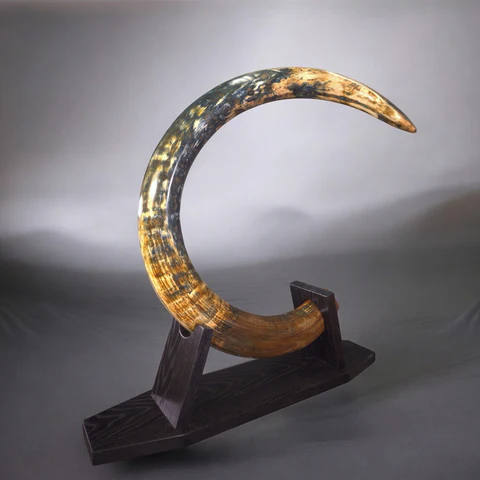
The patina is the surface color a woolly mammoth tusk gains during fossilization, and it is the single biggest driver of a tusk’s beauty and value. Collectors prize color, and the range is remarkable.
- Cream and amber. The lightest tusks keep much of their original tone, warmed to honey and amber by minerals. These read as classic ivory.
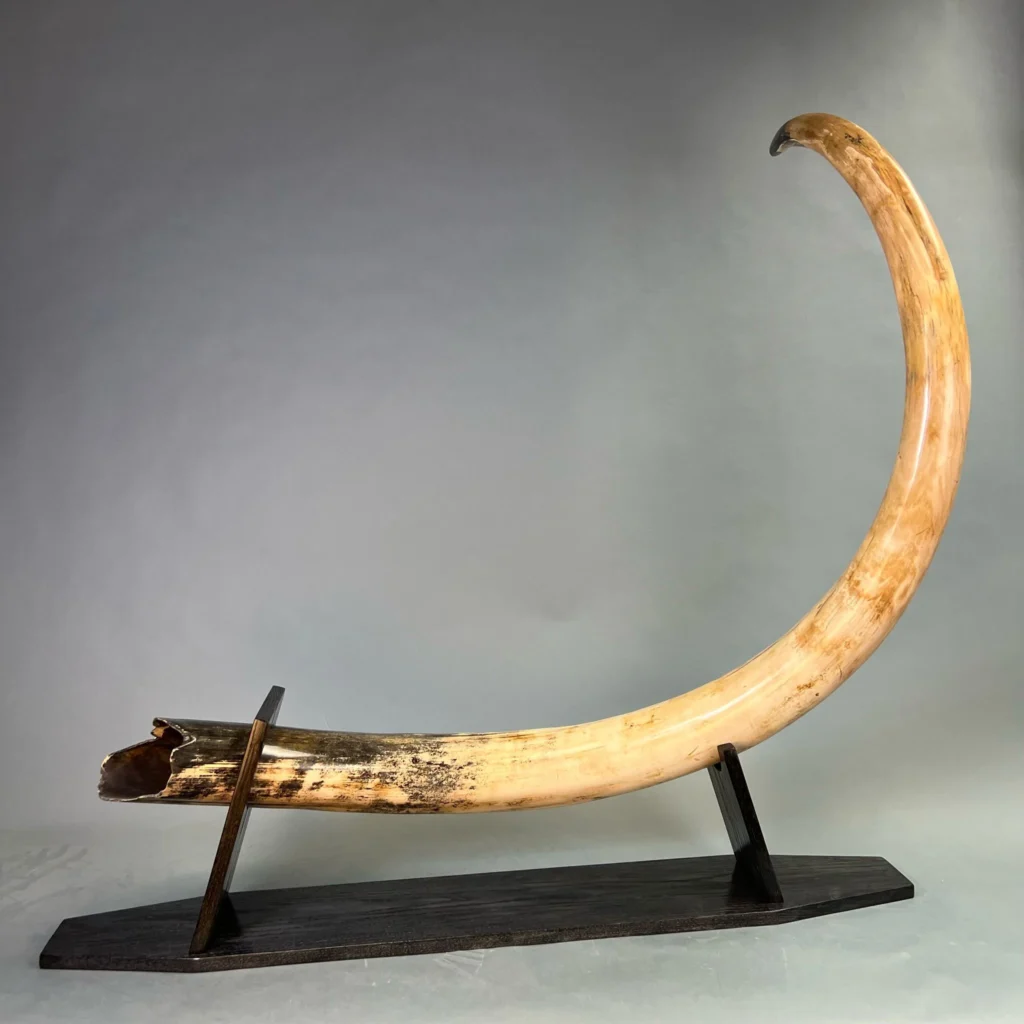
- Gold and tan. Iron staining pushes many tusks toward rich gold and tan. This is the most common patina and a favorite for display.
- Brown and chocolate. Deeper burial and heavier mineral content darken a tusk toward brown.
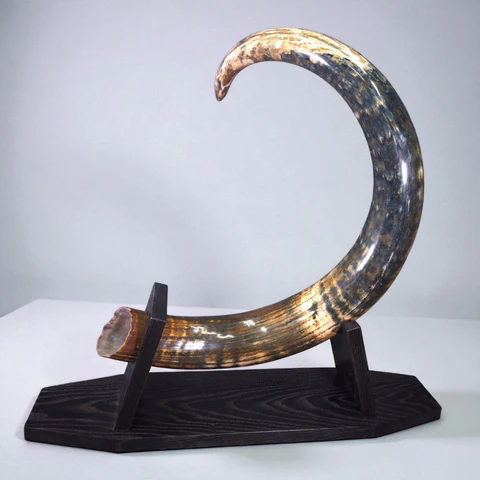
- Blue and black. The rarest and most sought-after color is blue. A blue-patinated mammoth tusk owes its color to vivianite, an iron phosphate mineral that forms in oxygen-poor ground and stains the ivory deep blue to black.
A tusk with a strong, even blue patina commands a premium because so few form that way. When you see one, you are looking at a rare chemical accident of the Ice Age. Color aside, collectors also value character: banding, contrast, and a surface that no other specimen shares.
Where woolly mammoth tusks come from
Most woolly mammoth tusks come from the permafrost of Siberia and Alaska, with a smaller number dredged from the North Sea. These are the regions where the mammoth steppe once stretched and where the cold has preserved the fossils.
- Siberia. The Yakutia region of Russia is the world’s richest source. As the permafrost thaws, tusks emerge from riverbanks and eroding ground each summer. Siberian tusks are famous for their size and color.
- Alaska. North American tusks surface from frozen ground and gold-mining tailings. Alaskan mammoth ivory is legal to collect and sell within the United States, subject to state rules.
- The North Sea. Fishing and dredging boats off the coast of the Netherlands pull up mammoth amounts of material from the drowned land that once joined Britain to Europe. These tusks are often darker and more mineralized from their time on the sea floor.
Provenance matters. A documented source adds value and confidence, and it helps you meet the legal requirements of your own country. Always ask where a tusk came from.
How big do woolly mammoth tusks get?
Woolly mammoth tusks range from small hand-held pieces to monumental specimens over nine feet long. Size drives both presence and price. The table below shows the tiers most collectors work within.
| Size tier | Typical length | Best for |
|---|---|---|
| Accent | 12 to 30 in | First fossil, desk, or shelf gifts |
| Mid-size | 30 to 60 in | Cabinets, studies, statement shelves |
| Large | 5 to 7 ft | Room centrepieces, galleries |
| Monumental | 8 ft and above | Grand interiors, institutions, lobbies |
Products by Category
-
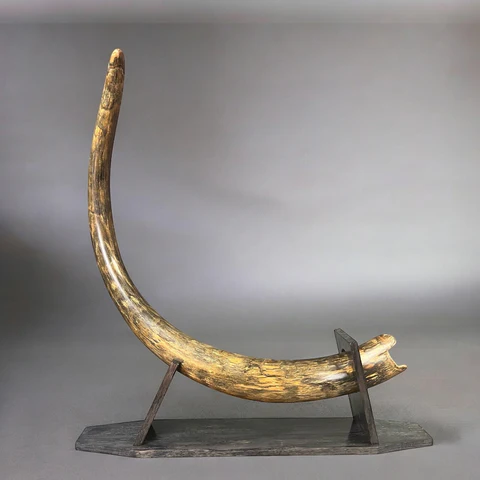
Fossilized Woolly Mammoth Tusk (Mammuthus primigenius, 64″)
-
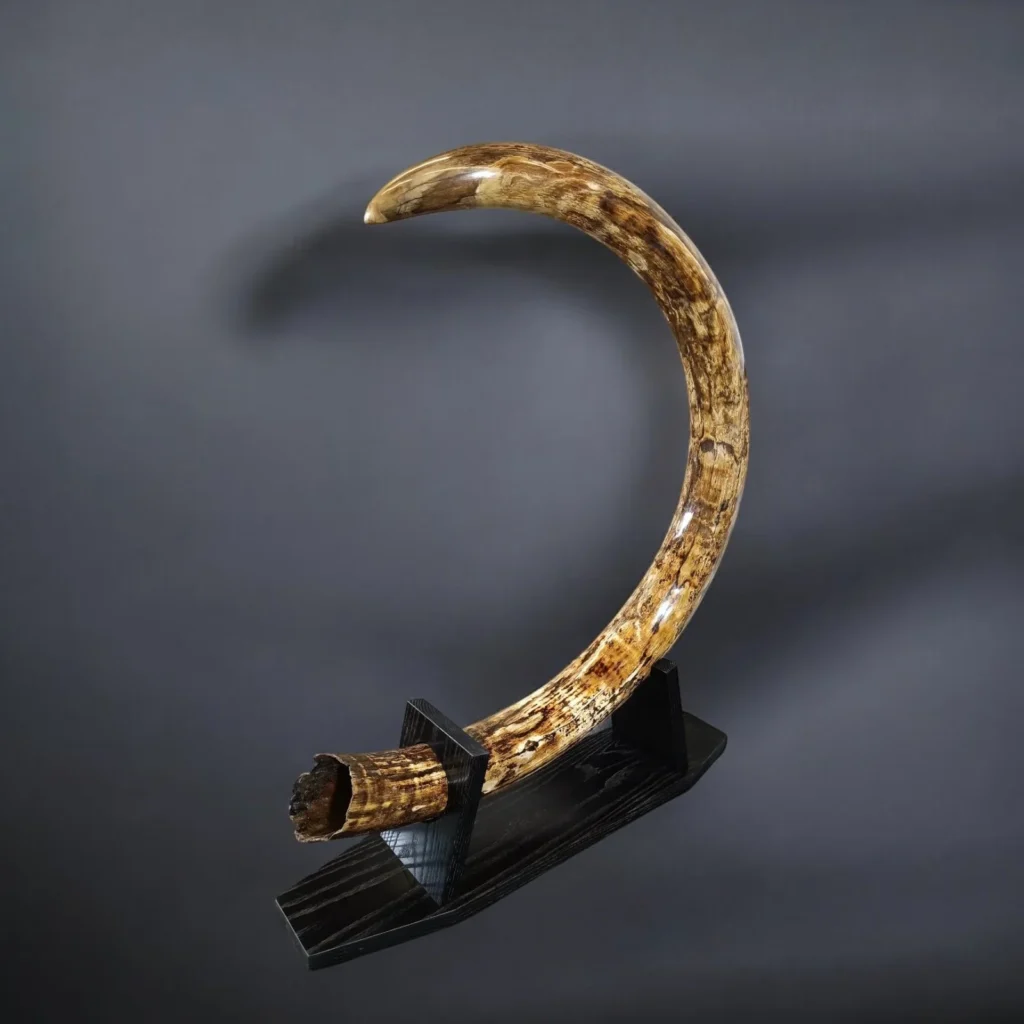
Large Woolly Mammoth Tusk (Mammuthus primigenius, 9′ / 100 lbs)
-
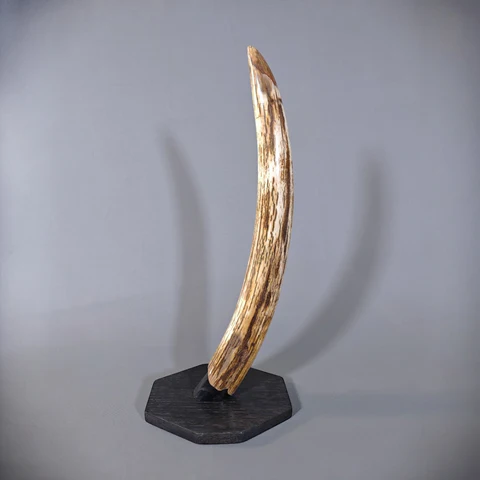
Woolly Mammoth Ivory Tusk (Mammuthus primigenius, 23.5″)
-
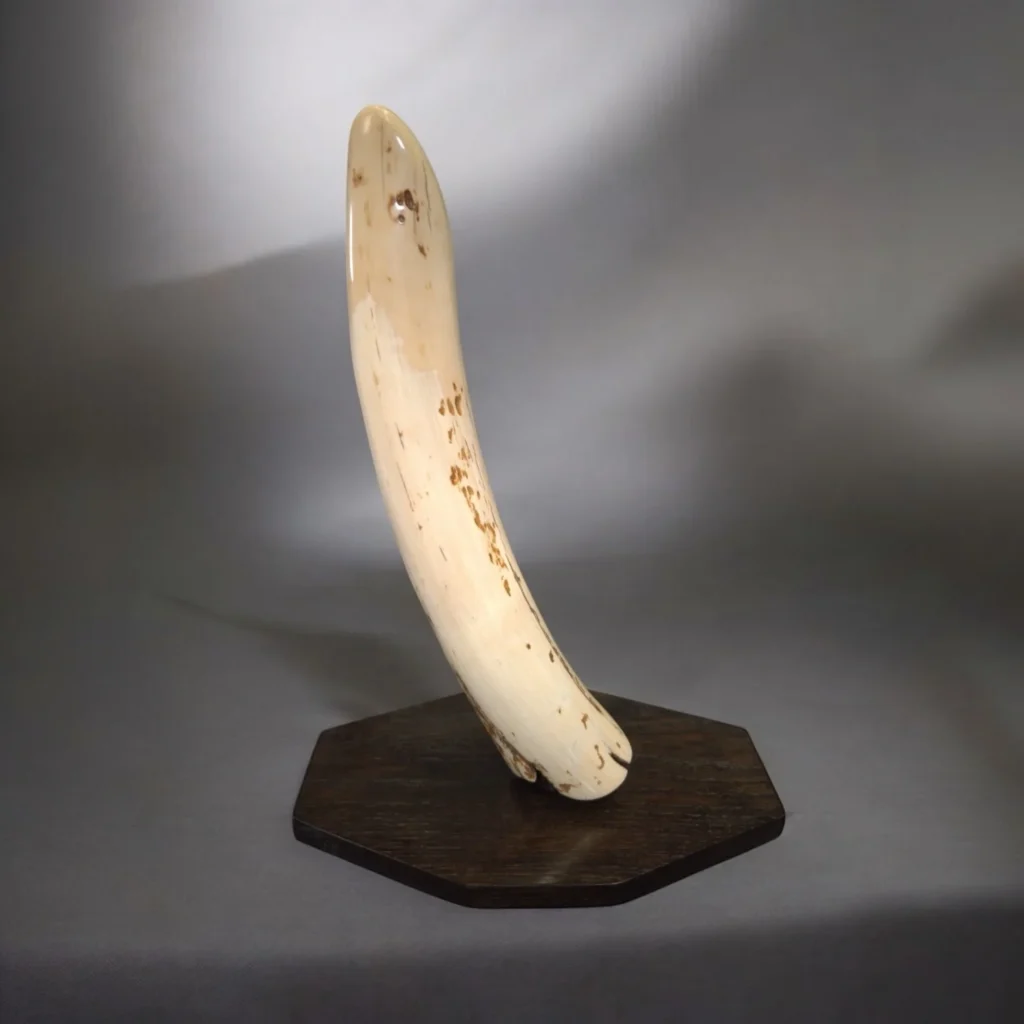
Woolly Mammoth Tusk (Mammuthus primigenius, 18″)
-
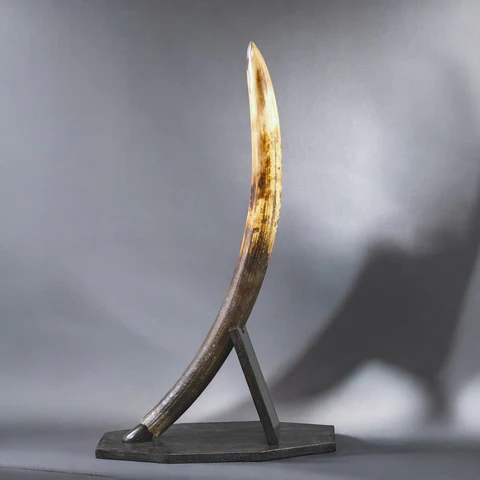
Woolly Mammoth Tusk (Mammuthus primigenius, 32.5″)
-
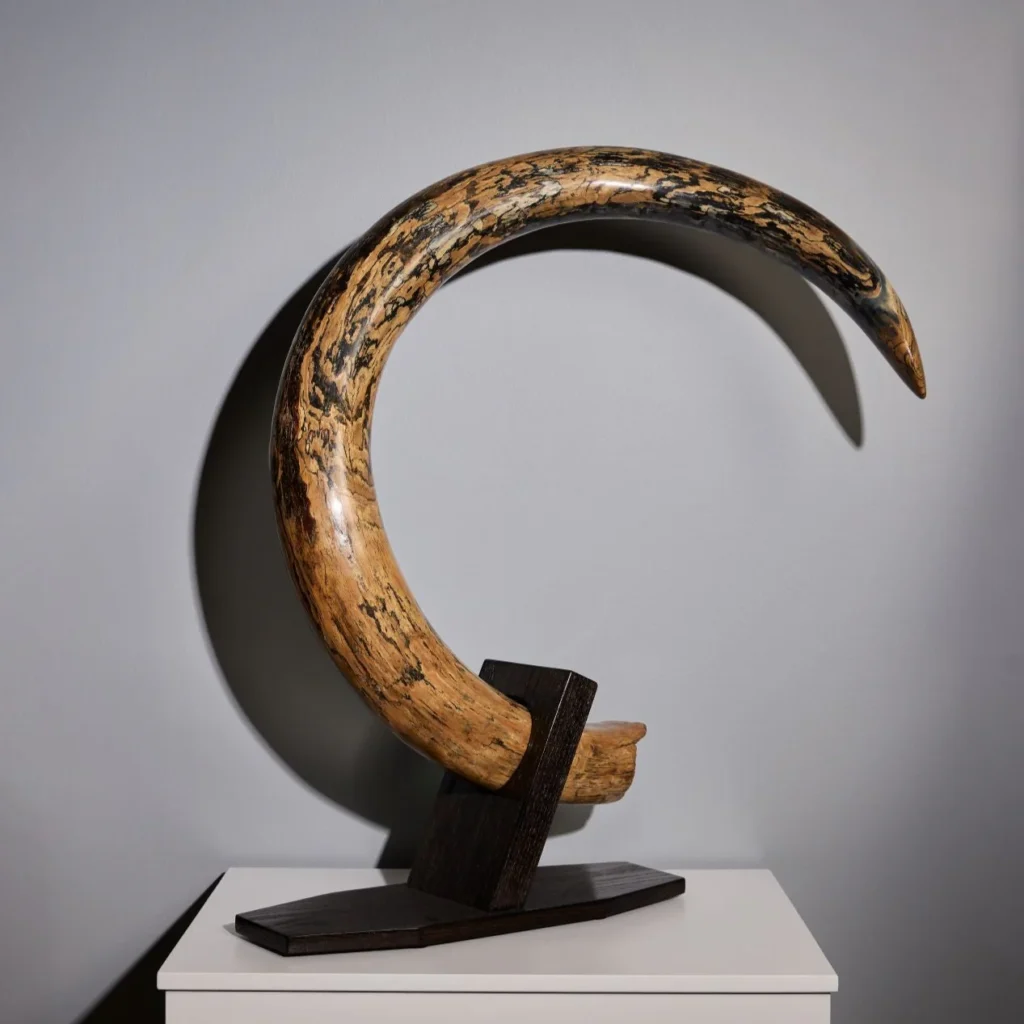
Woolly Mammoth Tusk (Mammuthus primigenius, 69″)
-
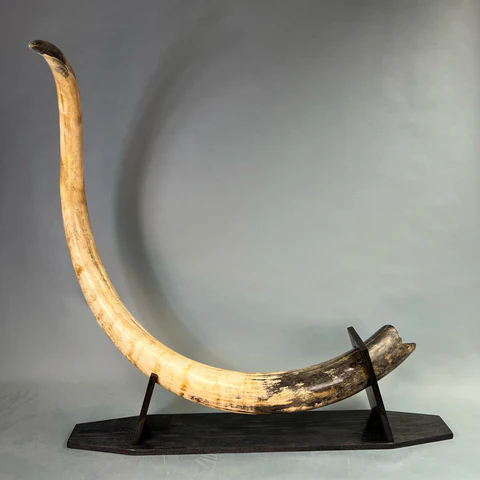
Woolly Mammoth Tusk (Mammuthus primigenius, 7′ 6″)
-
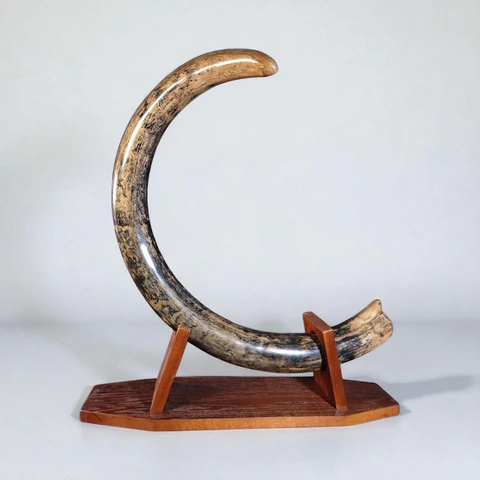
Woolly Mammoth Tusk (Mammuthus primigenius, 8′ / 86 lbs)
-
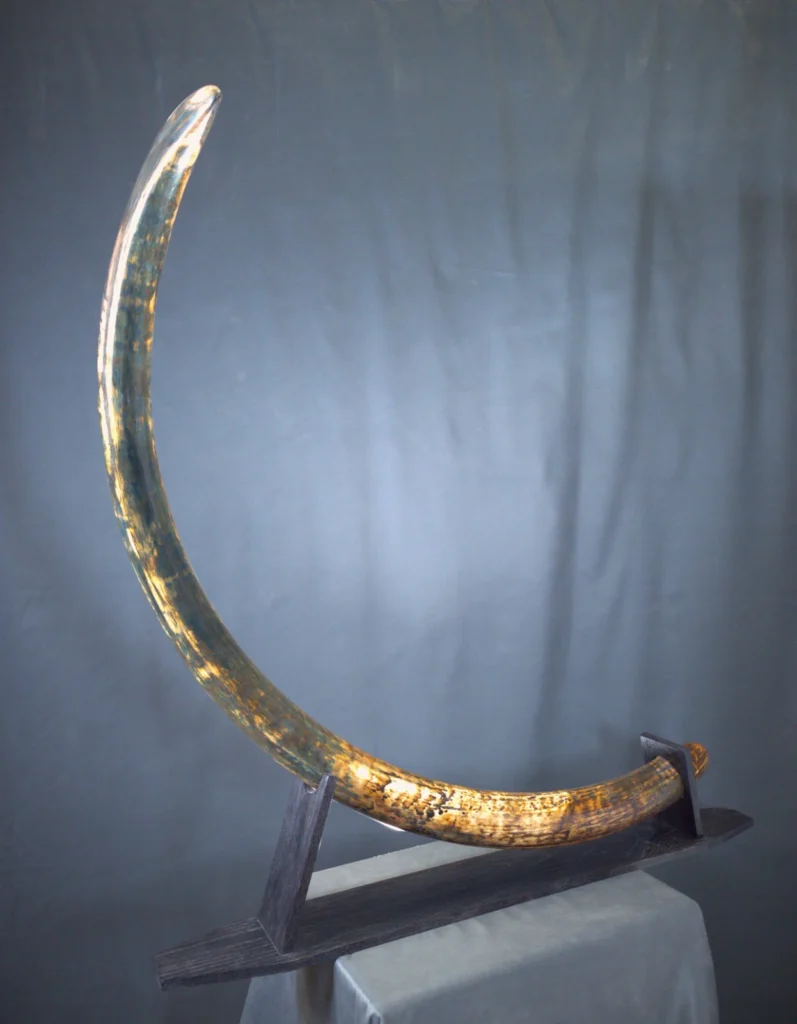
Woolly Mammoth Tusk (Mammuthus primigenius, 8′ 2″)
The largest tusks are heavy. A nine-foot specimen can weigh around one hundred pounds, which affects how you mount, display, and ship it. Smaller tusks and fragments carry the same fossil ivory and patina in a size anyone can house.
Real vs fake: how to tell a genuine woolly mammoth tusk
The most reliable way to tell a real mammoth tusk from a fake or from elephant ivory is the Schreger pattern in cross-section, backed by patina and weathering. Learn these signs and you will not be fooled.
The Schreger line test
Cut across any proboscidean tusk and you see Schreger lines, a fine crosshatch pattern sometimes called engine turning. The angles where these lines meet separate mammoths from elephants. In mammoth ivory, the outer angles are acute, below about ninety degrees. In elephant ivory, they are wider, above about 115 degrees. This is the test forensic labs use, and it is decisive.
Patina and age
A genuine fossilized mammoth tusk shows the color and character of long burial. Elephant ivory is pale and fresh by comparison. Age also brings fine cracking, called checking, along the length of a mammoth tusk. Modern reproductions in resin or bone lack both the Schreger pattern and true patina.
Weight and feel
Real fossil ivory is dense and cool to the touch. Resin fakes feel light and warm. If a tusk feels like plastic, it is plastic.
Documentation
Finally, buy from a seller who documents the fossil mammoth origin of each tusk. Paperwork does not replace your own eye, but combined with the signs above, it gives you confidence and helps with legal compliance.
Is it legal to own a woolly mammoth tusk?
In most of the world, yes. Because the woolly mammoth is extinct, it is not listed under CITES, the treaty that controls trade in endangered species. Elephant ivory is tightly banned. Mammoth ivory is not, which is why a woolly mammoth tusk for sale is legal where elephant ivory would not be.
There are important exceptions. Several United States states restrict or ban the sale of mammoth ivory to close loopholes in elephant ivory enforcement. These include California, New York, New Jersey, and others. Some countries also scrutinize all ivory at the border, and rules change. So while owning a mammoth tusk is legal for most buyers, you must confirm the rules where you live and where the tusk will ship.
Because this is the question buyers ask most, we cover it in depth in our dedicated guide to whether mammoth ivory is legal in your country and state. Read it before you buy across borders. As a rule, the tusk itself is legal in most places, but shipping is what to check.
How much is a woolly mammoth tusk worth?
A woolly mammoth tusk is worth anywhere from a few hundred to tens of thousands of euros, depending on five main factors. Understanding them helps you judge whether a price is fair.
- Size. Length and weight drive price more than anything. Monumental tusks cost the most.
- Patina. Color matters. A blue-patina mammoth tusk sells for a premium over a common gold one.
- Completeness. A whole, undamaged tusk is worth far more than a repaired or partial one.
- Provenance. Documented origin adds value and confidence.
- Preparation. Professional stabilization and a quality mount raise both value and display appeal.
As a rough guide, small accent tusks start in the low thousands, mid-size specimens sit in the mid-five figures, and large or monumental tusks with fine patina reach well beyond. For a full breakdown, see our guide on how much a mammoth tusk is worth. If a price looks far below the market, treat the provenance as suspect.
Woolly mammoth tusks vs other mammoth fossils
A tusk is the showpiece, but it is only one kind of mammoth fossil. Knowing the others helps you build a rounded collection and understand the wider market.
- Woolly mammoth teeth. Mammoth molars are large, ridged grinding teeth, replaced in sequence through life. Woolly mammoth teeth are affordable, fascinating, and a great teaching piece.
- Mammoth bones. Leg bones, vertebrae, and other mammoth bones turn up in the same deposits as tusks. They are heavy, dramatic, and often more affordable than ivory.
- Woolly mammoth skull. A full woolly mammoth skull is a rare and monumental fossil. Because complete skulls are so scarce and heavy, many collectors choose a cast replica instead. See our prehistoric replica skulls guide and our mammoth skull guide.
- Woolly mammoth skeleton. A mounted woolly mammoth skeleton is a museum-level acquisition, assembled from many bones and rarely available complete.
A single fossilized mammoth tusk gives you the animal’s most iconic feature in one striking object. Many collectors start there, then add teeth or bones over time.
How to display and care for a woolly mammoth tusk
Care for a woolly mammoth tusk by controlling light and humidity and handling it. Fossil ivory is durable but not indestructible, and good care protects both the specimen and its value.
- Light. Keep the tusk out of direct sunlight. Ultraviolet light fades patina and dries the ivory.
- Humidity. Aim for stable, moderate humidity. Big swings and very dry air cause the ivory to crack further along its natural checking.
- Temperature. Avoid heat sources, radiators, and cold drafts. Steady room temperature is best.
- Mounting. Display large tusks on a stable, purpose-made stand or mount that supports the full curve. A tusk that is poorly balanced can fall and shatter.
- Handling. Support the whole length when you move a tusk. Never lift a long specimen by one end. Wear clean, dry hands or soft gloves.
- Cleaning. Dust gently with a soft, dry brush. Do not soak fossil ivory or use household cleaners, which can stain or damage the surface.
A well-kept tusk holds its condition and value for generations. Treat it as the ancient artifact it is.
How to buy a woolly mammoth tusk
Buy a woolly mammoth tusk by matching size and patina to your space and budget, confirming provenance and legality, and choosing a seller who documents every specimen. Follow these steps and you will make a confident purchase.
- Set your space and budget. Decide where the tusk will live before you buy. An accent piece suits a shelf. A monumental tusk needs floor space and clearance for its curve.
- Choose your patina. Pick the color you love, whether warm gold or rare blue. Remember that blue commands a premium.
- Confirm provenance. Ask where the tusk came from and request documentation of its fossil mammoth origin.
- Check the law. Confirm that a mammoth tusk can ship to your address, since some regions restrict ivory.
- Inspect the specimen. Look at photographs of the full length, the tips, and any repairs. A good seller welcomes questions.
- Buy from a specialist. Choose a dealer who curates fossils, documents provenance, and packs and ships securely.
At The Bones Vault, every woolly mammoth tusk for sale is an authentic fossil, documented as to origin, and offered ready to display. Browse the full range in our woolly mammoth tusk collection.
Is mammoth ivory ethical?
Mammoth ivory is widely seen as ethical ivory because no animal is harmed to produce it. The woolly mammoth has been extinct for thousands of years. A tusk is collected from the ground, not taken from a living creature, which sets it apart from elephant ivory entirely.
This matters for two reasons. First, the elephant ivory trade drives the killing of a living, endangered species, which is why it is banned. Mammoth ivory carries none of that harm. Second, some conservationists argue that a legal supply of fossil mammoth ivory can reduce pressure on elephants by meeting demand for ivory without poaching. The argument is debated, but the core point stands: buying a fossilized mammoth tusk supports no hunting.
There is a responsible way to collect, even so. Buy documented specimens from sellers who source legally and are transparent about origin. Avoid any tusk with unclear provenance. Responsible sourcing keeps the market honest and keeps you clear of the strict rules that govern all ivory at borders.
Restoration, stabilization, and custom mounts
Most woolly mammoth tusks need some preparation before display, and quality work adds real value. When a tusk comes out of the ground, it is often cracked, fragile, or split along its length from thousands of years of freezing and thawing.
Skilled preparators stabilize a tusk by cleaning it, consolidating weak areas, and filling cracks so the specimen holds together. Done well, this preserves the natural patina and character while making the tusk safe to handle and display. Done badly, heavy restoration hides damage and lowers value. Ask any seller how much of a tusk is original and how much is restored.
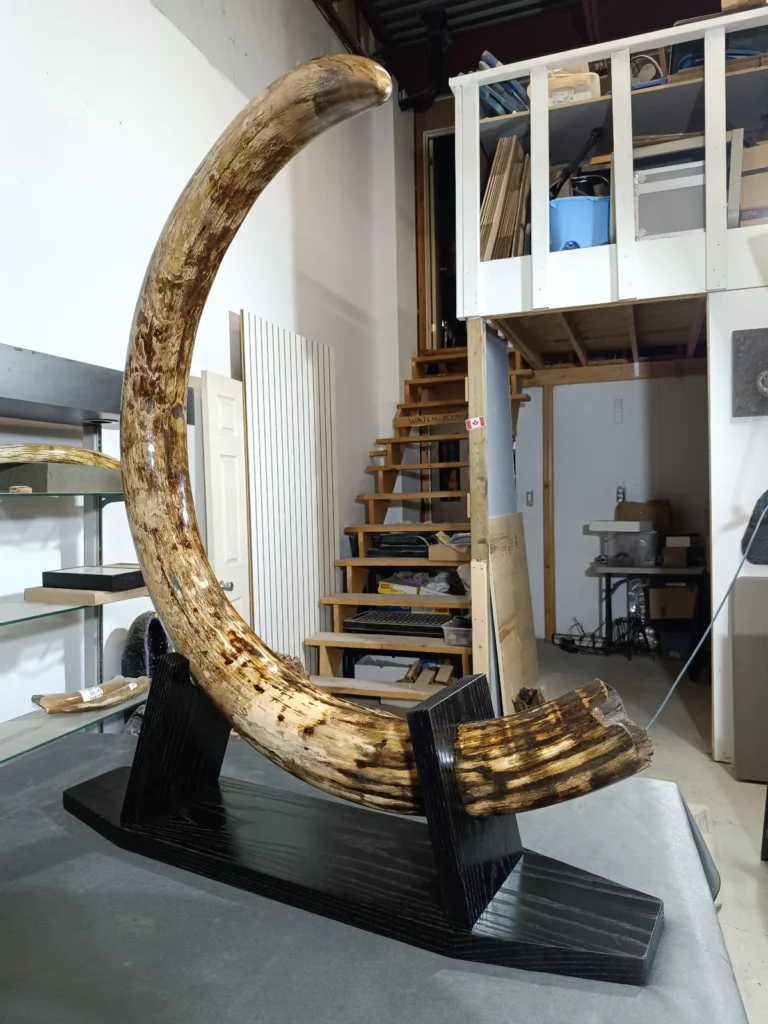
A custom mount finishes the piece. A large tusk needs a stand or bracket built to support its full curve and weight. A good mount protects the specimen, shows the curve to best effect, and lets you display a monumental tusk safely. When you compare a real mammoth tusk against another, factor in the quality of both its stabilization and its mount.
Common mistakes to avoid when buying
Avoid the four mistakes below and you will buy well.
- Ignoring the law. Owning a mammoth tusk is legal in most places, but shipping is restricted in some states and countries. Check destination rules before you pay.
- Skipping provenance. A tusk with no documented origin is harder to own legally and worth less. Always ask where it came from.
- Overlooking restoration. A price that looks low may reflect heavy repair. Ask how much of the tusk is original.
- Chasing size alone. A smaller tusk with rare blue patina and clean condition can be a better piece than a larger, damaged one. Balance size, color, and condition.
Frequently asked questions
Is it legal to own a woolly mammoth tusk?
In most places, yes. The woolly mammoth is extinct and not CITES-listed, so mammoth ivory is legal where elephant ivory is banned. Some US states restrict it and some countries scrutinize all ivory, so confirm the rules where you live and where the tusk will ship.
How much is a woolly mammoth tusk worth?
Anywhere from a few hundred to tens of thousands of euros. Size, patina, completeness, provenance, and preparation set the price. Small accent tusks start in the low thousands, while large tusks with a rare blue patina cost far more.
How can you tell a real mammoth tusk from elephant ivory?
Look at the Schreger lines in cross-section. Mammoth ivory forms acute angles below about ninety degrees, while elephant ivory forms wider angles above about one hundred and fifteen degrees. Genuine fossil ivory also shows patina and fine age cracking.
How old are woolly mammoth tusks?
Most are tens of thousands of years old. Woolly mammoths died out around four thousand years ago, and the tusks on the market fossilized in permafrost long before that.
Why are some mammoth tusks blue?
A blue patina forms when the mineral vivianite, an iron phosphate, stains the ivory during burial in oxygen-poor ground. Blue is the rarest and most valued color.
Where do woolly mammoth tusks come from?
Mostly the permafrost of Siberia and Alaska, with some dredged from the North Sea off the Netherlands. Thawing permafrost exposes new tusks each year.
How big do woolly mammoth tusks get?
The largest reach twelve to fifteen feet along the curve in big bulls. Most tusks for sale range from small accent pieces under thirty inches to monumental specimens over eight feet.
How do you care for a mammoth tusk?
Keep it out of direct sunlight, hold humidity stable, avoid heat, mount it securely and dust it with a soft dry brush. Do not soak fossil ivory or use household cleaners.
Start your collection
A woolly mammoth tusk is one of the most striking fossils you can own and one of the few pieces of legal ivory in the world. Whether you want a small accent piece or a monumental centerpiece, explore the woolly mammoth tusk collection at The Bones Vault. Every tusk is an authentic, documented fossil. We ship worldwide, with large tusks sent as insured freight and destination eligibility confirmed before sale.