
The Mammoth Skull: Tusks, Size, and the Cyclops Myth Explained
A mammoth skull is a massive, high-domed skull built to anchor two enormous curved tusks and a muscular trunk, and like its elephant cousins, it has a single large hole in the center of the face that once fueled myths of one-eyed giants. That central “eye” is not an eye at all: it is the nasal opening for the trunk. This guide explains everything about the woolly mammoth skull, from those spectacular tusks and its true size to the cyclops legend and the famous skulls dug from the ice.
You will learn what a mammoth skull looks like, why it has that towering dome, how big it really is, how it differs from an elephant skull, and where to find genuine mammoth material. Whether you are curious, studying the Ice Age, or collecting, you will get the full story here. Let’s dig in.
What does a mammoth skull look like?
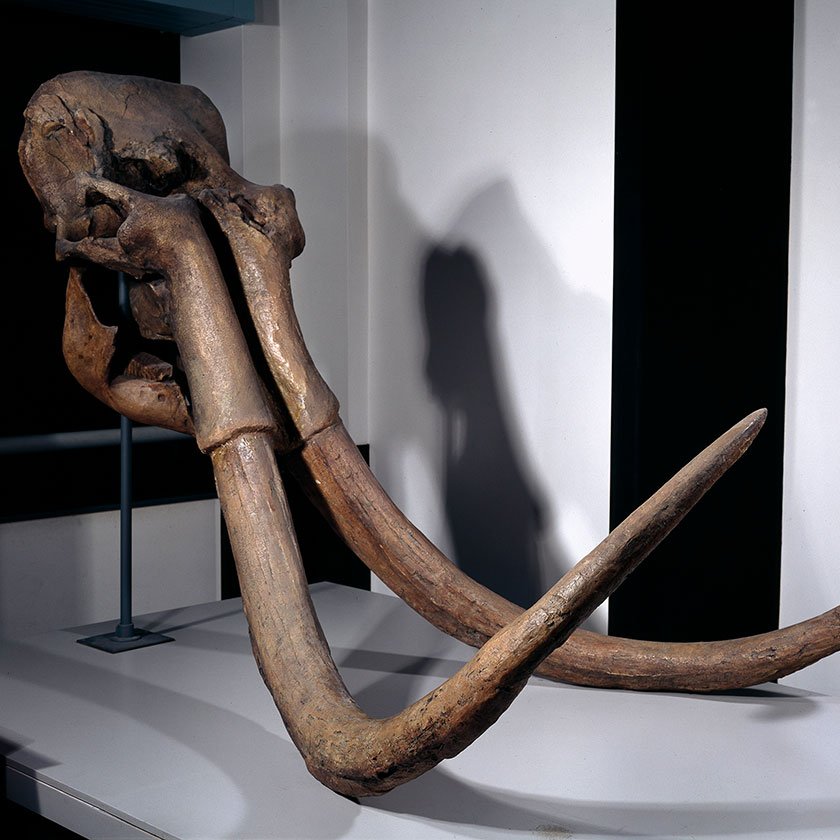
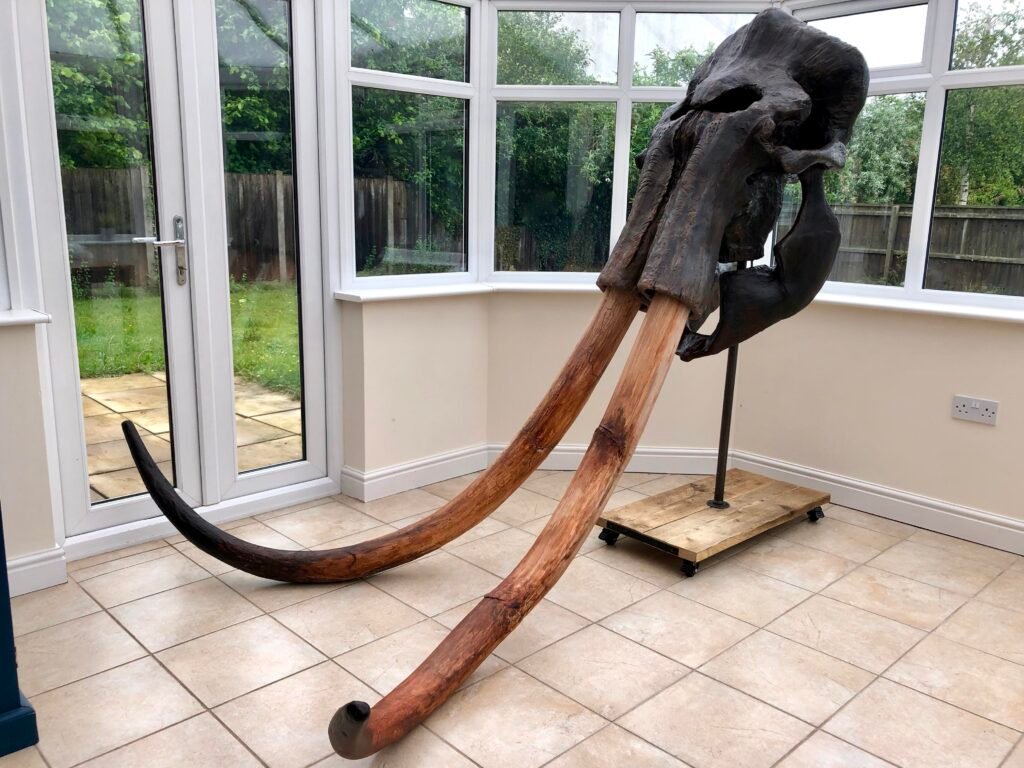
A mammoth skull looks like a tall, high-domed skull with a large central nasal hole, deep sockets holding two long curved tusks, and a relatively short, deep face. It is one of the most dramatic skulls of the Ice Age, instantly recognizable from its peaked forehead and enormous tusks.
The most striking features are the tusks, which curve out, forward, and then inward, sometimes crossing at the tips in old bulls. Above them sits the domed cranium, even taller and more peaked than an elephant’s, giving the mammoth its distinctive high-headed silhouette. And in the center of the face is that big single opening, the nasal cavity, that anchored the trunk and looks unmistakably like one giant eye.
Here is what stands out on a mammoth skull at a glance:
- Two long, curved tusks set in deep front sockets
- A tall, domed cranium (higher and more peaked than an elephant’s)
- A large central nasal hole (not an eye) that inspired cyclops myths
- A short, deep face with the tusk sockets dominating the front
- Massive ridged grinding molars deep in the jaws
What was a woolly mammoth?
Before going deeper into the skull, it helps to know the animal it belonged to, because the skull reflects the creature perfectly. The woolly mammoth was a large, cold-adapted relative of modern elephants that roamed the Ice Age steppes of Europe, Asia, and North America until around 4,000 years ago.
Covered in long, shaggy hair over a layer of insulating fat, the woolly mammoth was built for brutal cold. It stood roughly the height of a modern Asian elephant, with a distinctive sloping back, small ears (to reduce heat loss), and those enormous curved tusks. It fed on the tough grasses of the mammoth steppe, using its tusks to sweep snow aside. Everything about the skull—the tall dome, the deep tusk sockets, and the grinding molars—served this cold-climate, grazing, tusked giant. The woolly mammoth is the best known of several mammoth species, thanks to remarkably preserved specimens frozen in permafrost.
Why does a mammoth skull look like a cyclops?
A mammoth skull looks like a cyclops for the same reason an elephant skull does: the single large hole in the middle of the face, the nasal opening for the trunk, looks exactly like one enormous central eye socket. Ancient people who unearthed mammoth and elephant skulls, never having seen the living animal, may have imagined one-eyed giants.
This is one of the great stories in the history of fossils. Across Europe and the Mediterranean, people dug up the skulls of mammoths and their relatives long before anyone understood extinction or the Ice Age. A skull far larger than a human head, with a gaping “eye” in the center, was baffling. The one-eyed giants of Greek mythology, the Cyclopes, may well have been born from these discoveries.
The real eyes, as with elephants, sit lower and to the sides and are relatively small. So the “cyclops eye” is really the root of the trunk, hiding the true eyes in plain sight. It is a perfect example of how bones and fossils shaped human myth and legend, and it is why “mammoth skull cyclops” is such a popular search.
Mammoth tusks: the skull’s most spectacular feature
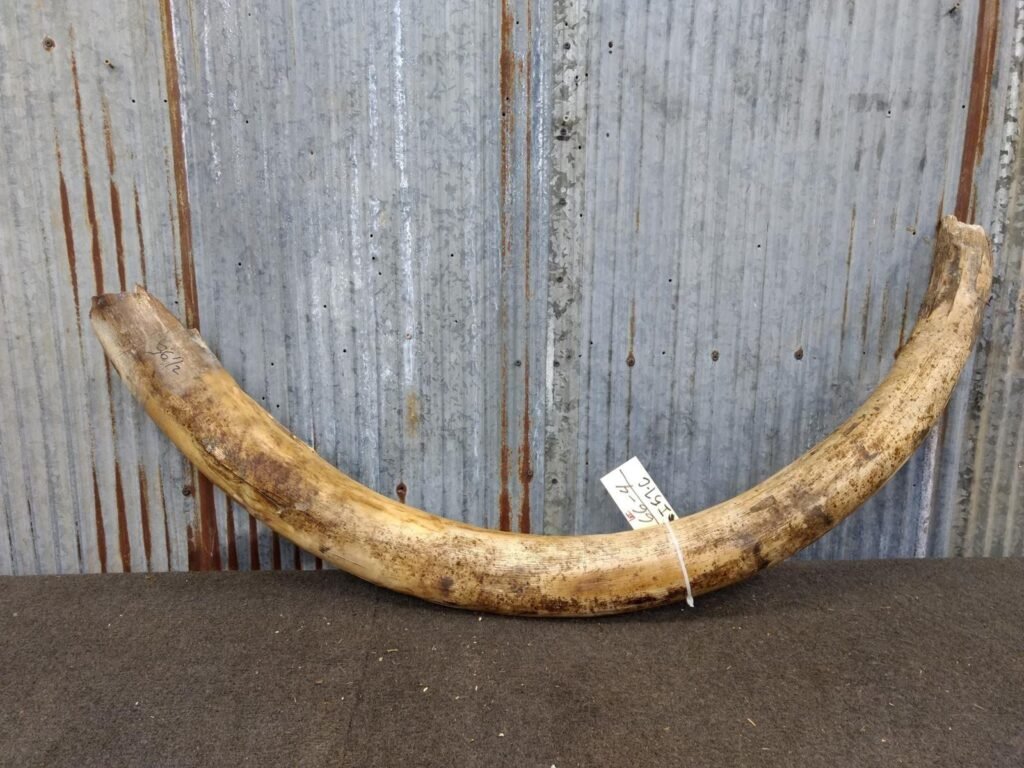
The tusks are the defining feature of any mammoth skull, and they are extraordinary. A mammoth’s tusks are massively elongated upper incisor teeth, not horns, that grew throughout the animal’s life and could reach 4 meters (13 feet) in the largest bulls.
Because they are teeth, tusks are made of dentine and grew from deep sockets in the front of the skull, which is why a mammoth skull has those large, deep channels at the front. The tusks curved dramatically, out and then up and inward, far more curved than an elephant’s, and old males sometimes had tusks that crossed at the tips. Mammoths used them to fight, to display, to strip bark, and to sweep snow off the vegetation they fed on through the long Ice Age winters.
Mammoth tusk ivory is now a major collector’s material, prized precisely because it comes from an extinct animal rather than a living elephant. We cover it in depth in our woolly mammoth tusk guide, and you can explore the legal side in our guide on whether mammoth ivory is legal.
Mammoth skull with tusks vs without
You will often see mammoth skulls listed with or without tusks, and the difference matters for both display and price. A mammoth skull with tusks is the complete, dramatic showpiece, and the tusks are usually the most valuable part. A mammoth skull without tusks shows the bare cranium and empty sockets and is more affordable and easier to display.
Genuine complete mammoth skulls with tusks are rare and valuable fossils. Many specimens on the market are either the skull alone, the tusks sold separately, or high-quality replicas of the complete skull. If it is the ivory you are drawn to, our mammoth tusk value guide explains what genuine tusks are worth.
Mammoth skull anatomy: built for the Ice Age
Mammoth skull anatomy follows the elephant plan but is pushed to Ice Age extremes, and every feature had a purpose. The skull had to anchor huge tusks, a powerful trunk, and enormous grinding teeth, while staying light enough to carry on a cold-adapted body.
Like elephants, mammoths solved the weight problem with a honeycomb of air cells filling the tall cranium, making the skull big but relatively light. The dome was even taller than an elephant’s, partly to anchor the neck muscles that supported the heavy head and tusks. Inside, the brain cavity was modest relative to the skull’s size. The whole structure is a masterpiece of engineering for a giant, tusked, cold-climate grazer.
Key features of mammoth skull anatomy include:
- A tall, air-filled domed cranium (light for its size)
- Deep tusk sockets (alveoli) at the front
- A large central nasal opening for the trunk
- Ridged grinding molars replaced in a conveyor-belt system
- Strong attachments for the neck muscles that carried the head and tusks
For how mammoth skulls compare to other animals, see our complete guide to animal skulls.
Mammoth teeth: the conveyor belt
Mammoth teeth are a marvel, and the skull shows how they worked. Like elephants, mammoths had just a few enormous grinding molars in use at once and replaced them in a conveyor-belt system throughout life, going through about six sets in total.
Each molar was a large slab ridged with hard enamel plates, perfect for grinding the tough grasses of the Ice Age steppe. As the front molar wore down, it fell out, and a new one pushed forward from behind. When the sixth and final set wore out in old age, the mammoth could no longer feed, which often marked the end of its life. These distinctive ridged teeth are so characteristic that a single mammoth molar is instantly identifiable.
How big is a mammoth skull?
A mammoth skull is big: the skull of an adult woolly mammoth could be over 90 cm (35 inches) long, and with the tusks the whole structure could span 4 meters or more. It is comparable in size to an elephant skull or larger in the biggest species.
Here is a rough size guide:
| Feature | Woolly mammoth skull | Notes |
|---|---|---|
| Skull length | ~90 cm+ (35 in+) | Similar to a large elephant |
| Tusk length | Up to 4 m (13 ft) | Curved, the largest in old bulls |
| Cranium shape | Tall, high-domed | Peaked, higher than an elephant |
The woolly mammoth was roughly the size of a modern Asian elephant, so its skull is on a similar scale, but the taller dome and far longer, more curved tusks make it look even more imposing. Larger species like the Columbian and imperial mammoths had bigger skulls still.
Mammoth skull vs elephant skull
Because mammoths and elephants are close relatives, people often ask how their skulls differ, and the distinctions are clear once you know them. Both are proboscideans, sharing the central nasal hole, tusk sockets, and grinding molars, but each has a signature.
A mammoth skull has a taller, more peaked dome and much longer, more dramatically curved tusks, often curving inward or crossing. An elephant skull has a lower dome (single-domed in African, twin-domed in Asian) and shorter, straighter tusks. Mammoth teeth also have more densely packed enamel ridges than elephant teeth, reflecting their grass-heavy diet. So if you see a tall-domed skull with long spiralling tusks, you are looking at a mammoth. Our guide comparing mammoth tusk vs elephant ivory explores the ivory differences, and our elephant skull guide covers the living cousins.
Famous mammoth skull discoveries
Part of what makes the mammoth skull so fascinating is that real ones keep turning up, often by accident, and these finds capture the public imagination. Mammoth remains have been unearthed across the northern hemisphere, from Siberian permafrost to American farmland.
In the United States, mammoth skulls and bones are found surprisingly often, and Michigan in particular has produced a string of famous discoveries, including skulls unearthed by farmers in their fields. Siberia’s thawing permafrost regularly yields astonishingly well-preserved mammoths, sometimes with skin, hair, and even stomach contents intact. Britain’s Natural History Museum famously holds a rare mammoth skull found in the UK. Each discovery adds to what we know about these Ice Age giants, and each one reminds us that the mammoth, though extinct for thousands of years, is never far beneath our feet. This is why searches like “mammoth skull found in Michigan” are so common; real finds make real news.
Different mammoth species and their skulls
Not all mammoth skulls are the same, and knowing the main species helps you identify and value a specimen. “Mammoth” covers several species, and their skulls varied in size and shape.
The woolly mammoth is the famous Ice Age species, with a tall, peaked dome and tightly curled tusks, superbly adapted to cold. The Columbian mammoth, which lived in warmer parts of North America, was larger, with an even bigger skull and long, sweeping tusks. The imperial mammoth was among the largest of all. Earlier, dwarf species existed too, including the island dwarf mammoths whose small, human-sized skulls, like those of dwarf elephants, likely fed the cyclops legend. When you see a mammoth skull described as woolly, Columbian, or imperial, that tells you its species, size, and likely origin.
Real mammoth skull vs replica: which should you choose?
If you want a mammoth skull for display, you have two routes, and for most people the choice comes down to budget and authenticity. A real mammoth skull or tusk is a genuine Ice Age fossil; a replica is an accurate, affordable cast of the complete skull.
Here is how they compare:
| Factor | Real mammoth material | Replica skull |
|---|---|---|
| What it is | Genuine fossil bone or ivory | Resin cast |
| Completeness | Often tusks/teeth alone; full skulls rare | Full skull with tusks |
| Price | Tusks attainable; complete skulls very high | Moderate |
| Legality | Legal in most places (not CITES) | No restrictions |
| Best for | Collectors wanting the real Ice Age | Display, teaching, full-skull impact |
Here is a clear recommendation. If you want the genuine article at an attainable price, buy a real mammoth tusk or molar rather than holding out for a rare complete skull. If you want the full skull-and-tusks showpiece on a budget, a quality replica delivers the drama. For accurate casts, see our guide to replica and model skulls.
Is it legal to own a mammoth skull?
Owning a mammoth skull or mammoth ivory is legal in most places, and this is a key advantage of mammoth material over elephant ivory. Because the woolly mammoth is extinct and not covered by CITES, mammoth ivory is not subject to the international ban that applies to elephant ivory.
That said, rules vary. A few US states restrict the sale of all ivory, including mammoth, and some countries have their own controls, so you should confirm your local law before buying. But in general, genuine mammoth tusks and skulls are legal to buy, own, and sell, which is exactly why they have become such a popular ethical alternative to elephant ivory. We explain the full picture in our detailed guide on whether mammoth ivory is legal.
Where to buy a real mammoth skull or tusk
You can buy genuine mammoth material, from complete skulls to individual tusks and teeth, from a specialist dealer who documents provenance and legality. Complete mammoth skulls with tusks are rare and expensive fossils, so many collectors start with a genuine tusk, a molar, or a quality replica of the full skull.
When buying, choose a dealer who confirms whether a piece is a genuine fossil or a replica, documents its origin (often Siberia or Alaska), and understands the ivory rules for your location. A real mammoth tusk is a spectacular, legal piece of the Ice Age and a more attainable way to own genuine mammoth material than a complete skull. Browse our collection of genuine woolly mammoth tusks at The Bones Vault, each documented and shipped worldwide in secure, insured packaging. Questions about a specimen’s origin or the ivory rules where you live? Message us on WhatsApp before you buy; we will answer personally.
Why did mammoths go extinct?
The mammoth’s disappearance is one of the great questions of the Ice Age, and it adds poignancy to every mammoth skull you see. Woolly mammoths died out around 4,000 years ago, with the last small population surviving on remote Wrangel Island off Siberia after mammoths had vanished everywhere else.
Two forces are blamed, and most experts point to a combination of both. As the Ice Age ended, the cold steppe that mammoths depended on shrank rapidly with the warming climate, breaking up their habitat and food supply. At the same time, human hunters spread across their range, adding pressure a shrinking population could not withstand. Climate change and human hunting together most likely sealed the mammoth’s fate. That makes a mammoth skull more than a fossil: it is a relic of a lost world and a cautionary tale about how quickly even a giant can vanish. It is also why mammoth ivory can be collected ethically today: no living animal is harmed, and the material comes from creatures gone for thousands of years.
The mammoth skull in art and culture
The mammoth skull has captured human imagination since the Ice Age itself, and that deep cultural resonance is part of its appeal. Early humans lived alongside mammoths, hunted them, and painted them on cave walls; some of the oldest art on Earth features these tusked giants.
Today the mammoth skull remains a powerful symbol of the ancient past, extinction, and Ice Age wilderness. It appears in art, tattoo design, and gaming, and “mammoth skull” is a popular motif representing primal strength and deep time. As a genuine fossil or a striking replica, it anchors any natural history collection with a direct connection to the last age of ice. For more on why skulls hold such meaning, see our guide to skull symbolism and meaning, and for display ideas, our cabinet of curiosities guide.
Frequently asked questions
Why does a mammoth skull look like a cyclops?
Because of the single large hole in the center of its face. That hole is the nasal opening for the trunk, but it looks just like one giant eye socket. Ancient people who found mammoth and elephant skulls, never having seen the living animal, may have imagined one-eyed giants, the Cyclopes of Greek myth.
Are mammoth tusks teeth?
Yes. Mammoth tusks are massively elongated upper incisor teeth made of dentine, not horns. They grew throughout the animal’s life from deep sockets in the skull and could reach 4 meters in the largest bulls.
How big is a mammoth skull?
A woolly mammoth skull could be over 90 cm (35 inches) long, and with the tusks the whole structure could span 4 meters or more. It is similar in size to an elephant skull but with a taller dome and far longer, curved tusks.
What is the difference between a mammoth skull and an elephant skull?
A mammoth skull has a taller, more peaked dome and much longer, more curved tusks, often curving inward or crossing. An elephant skull has a lower dome and shorter, straighter tusks. Mammoth molars also have more densely packed enamel ridges.
Is it legal to own a mammoth skull?
In most places, yes. The woolly mammoth is extinct and not covered by CITES, so mammoth ivory is not subject to the elephant ivory ban. A few US states and some countries restrict all ivory, so confirm your local law before buying.
Where are mammoth skulls found?
Across the northern hemisphere, especially in Siberian permafrost and North American farmland. Michigan is famous for mammoth finds, and Siberia regularly yields remarkably preserved specimens. Britain’s Natural History Museum holds a rare UK mammoth skull.
How much does a mammoth skull cost?
Complete genuine mammoth skulls with tusks are rare and expensive, often reaching tens of thousands. Individual tusks, molars, and replicas are far more affordable ways to own mammoth material. Price depends on completeness, size, condition, and provenance.
Own a piece of the Ice Age.
The mammoth skull is one of the most spectacular objects in natural history: those sweeping tusks, the towering dome, the central “eye” that launched cyclops legends, and the thrill of specimens still emerging from the ice. Now you know the full story behind it.
Ready to own genuine mammoth material? Browse our documented woolly mammoth tusks, explore our complete woolly mammoth tusk guide, or learn the law in our guide on whether mammoth ivory is legal. Every specimen is documented, legal, and ships worldwide in secure, insured packaging. Questions? Message us on WhatsApp or email us. We are here to help.