
Forensic Anthropology: How Experts Read the Human Skull
Forensic anthropology is the application of the study of human bones to legal and criminal investigations, and the skull is its single most valuable tool. From a skull alone, a forensic anthropologist can estimate a person’s age, biological sex and ancestry, and even help rebuild what their face looked like. This guide explains how forensic anthropology reads the human skull, the techniques of age, sex and ancestry estimation, how facial reconstruction works, and how to become a forensic anthropologist.
This is a companion to our complete guide to the human skull, focused on how the skull is analysed in forensic science.
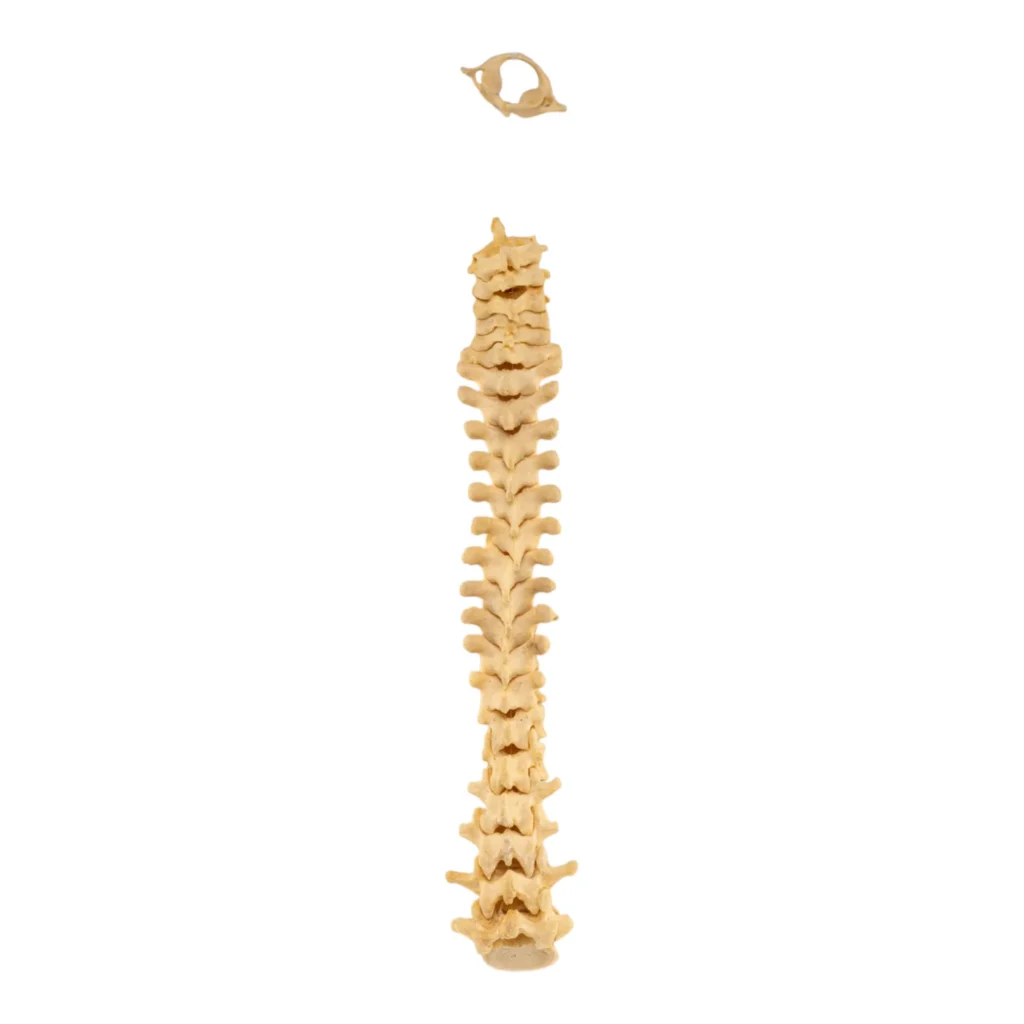
What is forensic anthropology?
Forensic anthropology is the branch of physical anthropology that applies the study of the human skeleton to matters of law. When human remains are found, whether at a crime scene, a disaster site or an archaeological dig, a forensic anthropologist examines the bones to help establish who the person was and what happened to them.
The discipline sits at the meeting point of anthropology, anatomy and criminal investigation. A forensic anthropologist works from the skeleton, often incomplete, to build a biological profile: the person’s age, sex, ancestry and stature, along with any signs of injury, disease or distinctive features. This profile helps investigators narrow down a possible identity. Because bone survives long after soft tissue is gone, forensic anthropology is often the only way to answer these questions from older or badly decomposed remains.
A brief history of forensic anthropology
Forensic anthropology is a relatively young science, and knowing its origins helps explain how it works today. Its roots lie in the nineteenth century, when anatomists and early anthropologists first applied the systematic study of the skeleton to questions of identity. As anatomy and physical anthropology matured, so did the ability to read age, sex and ancestry from bone.
The field grew significantly through the twentieth century, particularly as it was called upon to identify the remains of war casualties, a demand that drove major advances in skeletal identification. Over time, forensic anthropology became a formal discipline with professional standards, reference collections and established methods. Today it is a recognised forensic science, drawing on large databases of skeletal data, advanced imaging, and increasingly digital and statistical methods, while still resting on the same foundation: the careful reading of bone, and above all the skull, that its pioneers began. This long refinement is why the techniques described below are as reliable as they are.
Why the skull is the key to forensic analysis
Of all the bones in the body, the skull is the most informative to a forensic anthropologist, which is why so much analysis centres on it. The skull carries more identifying information than any other single bone, because its features vary in consistent, measurable ways with age, sex and ancestry.
The skull is also durable. Its dense bone often survives when more fragile bones are lost or damaged, so it is frequently the best-preserved evidence available. And it is the foundation of the face, which means it can be used to reconstruct a person’s appearance. For all these reasons, when a forensic anthropologist receives skeletal remains, the skull is usually the first and most important focus of analysis. Understanding the skull’s detailed anatomy is the foundation of everything that follows.
Estimating age from the skull
One of the first questions a forensic anthropologist answers is how old the person was, and the skull provides several clues that together give a reliable estimate. The techniques rely on the fact that the skull changes in a predictable sequence across a lifetime, as covered in our skull development guide.
The main age indicators in the skull are:
- Suture fusion. The sutures joining the skull bones fuse very gradually across adult life. The degree of fusion helps place a person in a broad age range.
- Teeth. Dental development is one of the most accurate age markers, especially in the young. The eruption of milk teeth, then adult teeth, then the wisdom teeth follows a known timeline, and wear on the teeth increases with age.
- Fontanelles and bone growth. In infants and children, open fontanelles, unfused bones and developing teeth clearly indicate a young age.
- General bone texture. Bone becomes denser and then, in old age, can show changes that give further clues.
No single feature gives an exact age. Instead, the anthropologist combines several indicators to estimate a range, and the younger the individual, the more precise the estimate, because development happens on a tighter schedule in youth.
Estimating sex from the skull
Forensic anthropologists can often estimate biological sex from the skull, using a set of features that tend to differ between males and females. These are statistical tendencies rather than absolute rules, so experts assess several features together for a reliable estimate.
The main features used include:
- The brow ridge. The ridge of bone above the eyes tends to be more prominent in males and smoother in females.
- The mastoid process. The bony bump behind the ear tends to be larger and more robust in males.
- The forehead. Males tend to have a more sloping forehead, females a more vertical one.
- The jaw and chin. Males tend to have a squarer, more robust jaw and chin; females a more pointed or rounded one.
- The overall size and robustness. Male skulls tend on average to be larger and more heavily built, with more pronounced muscle-attachment markings.
Because these are population tendencies with considerable overlap, sex estimation from the skull is expressed as a probability rather than a certainty, and it is most reliable when the whole skull, ideally with the pelvis, is available. It is a skilled judgement built from many small observations.
Estimating ancestry from the skull
Forensic anthropologists may also assess ancestry, the broad population background of an individual, from features of the skull. This is one of the more complex and carefully handled areas of the discipline, because human variation is continuous and does not fall into neat categories.
Experts examine features such as the shape of the face, the form of the nasal opening, the projection of the jaws and the proportions of the skull, comparing measurements against reference data from documented populations. The results are expressed cautiously, as a most-likely background rather than a definitive label, and modern forensic anthropology treats ancestry estimation with great care, aware both of its investigative usefulness and of the need to avoid oversimplifying human diversity. It is one part of building a biological profile, always weighed alongside age, sex and stature.
Forensic facial reconstruction
One of the most striking things a forensic anthropologist can do is help rebuild a person’s face from their skull, a process called forensic facial reconstruction. Because the skull is the foundation of the face, its shape determines much of how a person looked, and this makes reconstruction possible.
There are two main approaches. In manual reconstruction, a sculptor builds a face directly onto a cast of the skull, using clay. Pegs mark the average thickness of soft tissue at points across the face, based on population data, and the sculptor fills in the features between them, guided by the skull’s structure. In digital reconstruction, the same principles are applied on a computer, using a 3D scan of the skull and specialist software to build the face virtually.
Neither method produces a perfect portrait, since details like exact skin tone, hairstyle and expression cannot be read from bone. But a good reconstruction captures the overall look closely enough that someone might recognise the person, which can generate leads in an investigation. Facial reconstruction is also used in archaeology and museums to bring the faces of ancient and historical people back to life, one of the most publicly fascinating applications of the science.
Reading injury and identity from the skull
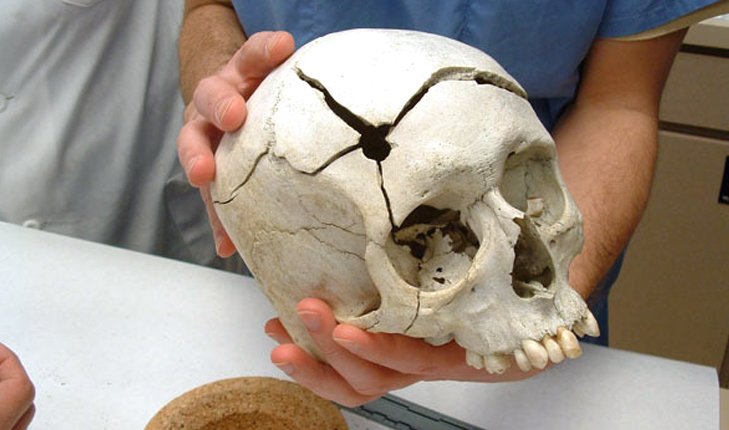
Beyond the biological profile, the skull can reveal what happened to a person and help confirm exactly who they were. Forensic anthropologists examine the skull for signs of trauma, distinguishing injuries that occurred around the time of death from older, healed injuries and from damage that happened after death. The pattern of a fracture, for example, can indicate the kind of force involved.
The skull also carries features that can confirm identity. Old healed injuries, dental work, the unique pattern of the sinuses, and other individual traits can be matched against medical and dental records of a missing person. In this way the skull moves the investigation from a general profile, roughly this age, sex and ancestry, toward a positive identification of a specific individual. This combination of profiling and identification is the heart of forensic skull analysis.
Forensic anthropology vs forensic archaeology
Two related fields are often confused, and it is worth clarifying the difference. Forensic anthropology is the analysis of the human remains themselves, the bones, and what they reveal about the person. Forensic archaeology is the application of archaeological methods to a forensic context, the careful location, excavation, and recording of buried or scattered remains and evidence at a scene.
The two work closely together. A forensic archaeologist recovers the remains and documents their context with the same rigor used on an archaeological dig, preserving vital evidence about how they came to be there. The forensic anthropologist then analyses the recovered bones. Together they turn a scene of scattered remains into a reconstructed account of who the person was and what happened, one recovering the evidence and one reading it.
Where forensic skull analysis is used
Forensic anthropology is applied in a wider range of situations than many people realize, and seeing them shows why the skill is so valued. The analysis of the skull and skeleton plays a role across several fields.
In criminal investigations, forensic anthropologists help identify victims and understand how they died, often when remains are skeletonised, burned or otherwise beyond ordinary identification. In mass disasters, such as plane crashes, fires and natural catastrophes, they help identify large numbers of victims from fragmentary remains, bringing answers to families. In human rights and war-crimes investigations, they exhume and identify victims from mass graves, providing evidence for justice and closure for communities. In historical and archaeological work, the same techniques identify and reconstruct people from the distant past, from ancient burials to famous historical figures.
In every case, the human skull is central to the work, offering its evidence of age, sex, ancestry and identity. This breadth is part of what makes forensic anthropology such a compelling field, and why the ability to read a skull is a genuinely valuable skill. It turns silent remains into a name and a story.
How to become a forensic anthropologist
Forensic anthropology is a demanding but fascinating career, and it draws a lot of interest, which is why so many people search for how to enter the field. The path is largely academic and requires significant study.
The typical route runs through higher education in anthropology, with a focus on physical or biological anthropology and osteology, the study of bones. Most practising forensic anthropologists hold advanced degrees, often a master’s and frequently a doctorate, because the work requires deep expertise in skeletal analysis. Training combines anatomy, human variation, archaeology and forensic method, and hands-on experience with real skeletal collections is essential.
Career paths include working with universities, medical examiner and coroner offices, law enforcement, the military (identifying remains of service personnel), and international organisations investigating disasters and human rights cases. Related roles include forensic archaeologist and forensic osteologist. It is a competitive field, so a strong academic record, practical experience and specialist training all matter. For anyone drawn to it, a fascination with the human skeleton, and especially the skull, is where it begins.
Beyond the skull: the full biological profile
While the skull is the centrepiece, a forensic anthropologist reads the whole skeleton to complete the picture, and it helps to see how the skull fits into that wider analysis. The other bones add information the skull alone cannot give.
Stature, a person’s height, is estimated mainly from the long bones of the arms and legs, using formulas that relate bone length to height. The pelvis is the most reliable single indicator of biological sex, even more so than the skull, because its shape differs clearly between males and females for reasons related to childbirth. Overall robustness and muscle markings across the skeleton give further clues to build, activity and sometimes occupation. And the bones as a whole may carry signs of age, disease, healed injury and lifestyle.
The forensic anthropologist assembles all of this, the skull’s evidence of age, sex, ancestry and identity, plus the pelvis, the long bones and the rest, into a single biological profile. The skull leads the analysis, but it is strongest when read alongside the whole skeleton. This is why a complete set of remains allows a far more confident conclusion than a skull alone, though the skull remains the most information-rich single piece.
Modern technology in forensic skull analysis
Forensic skull analysis has been transformed by modern technology, and it is worth understanding how the traditional reading of bone now combines with digital tools. CT scanning and 3D imaging allow a skull to be captured digitally, measured with great precision, and compared against large reference databases without handling the fragile original. This has made age, sex and ancestry estimation more consistent and repeatable.
Digital facial reconstruction, described above, is one visible product of this shift, replacing or supplementing clay sculpture with computer modelling. Statistical software now underpins many estimates, comparing a skull’s measurements against thousands of documented cases to express results as probabilities. DNA analysis, where it is possible, can confirm an identity that skeletal analysis has narrowed down. None of this replaces the trained eye of the forensic anthropologist, who still interprets the results, but together these tools have made the reading of the skull faster, more precise and more objective than ever. It is a field where an ancient object, the human skull, meets cutting-edge science.
Studying skulls for forensic learning
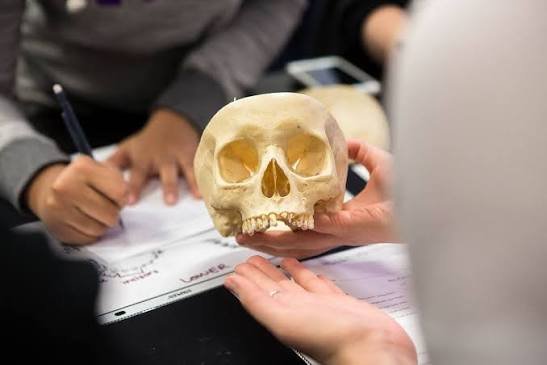
Because forensic anthropology depends on reading real bone, hands-on study of skulls is central to learning it. Students build their skills by examining skeletal material, learning to spot the age, sex and ancestry indicators described above, and to measure and compare skulls accurately.
This is why real and replica skulls are important teaching tools in the field. A quality specimen or model lets a student practise identifying the brow ridge, the mastoid process, the sutures and the other features that a forensic analysis relies on. Comparing skulls of different ages and characteristics turns textbook knowledge into practical skill. Explore our human skull collection and our detailed anatomy guide to study the structure that forensic anthropologists read.
Frequently asked questions
What is forensic anthropology?
Forensic anthropology is the application of the study of human bones to legal and criminal investigations. A forensic anthropologist examines skeletal remains to estimate a person’s age, sex, ancestry, and stature and to help identify them and understand what happened.
What does a forensic anthropologist do?
A forensic anthropologist analyzes human skeletal remains to build a biological profile, estimating age, sex, ancestry, and stature; identifying signs of trauma; and helping to identify the individual. They often work with law enforcement, medical examiners, and disaster or human rights investigations.
How do you estimate age from a skull?
By combining several indicators: the degree of suture fusion, dental development and wear, and, in the young, the state of the fontanelles and growing bones. Together these place a person in an age range, most precisely in children and young adults.
How do you tell the sex of a skull?
By assessing features that tend to differ between males and females, such as the brow ridge, mastoid process, forehead slope, jaw and chin shape, and overall robustness. These are statistical tendencies, so experts weigh several features together.
What is forensic facial reconstruction?
It is the process of rebuilding a person’s face from their skull, either by sculpting clay onto a cast using tissue-depth data, or digitally from a 3D scan. It captures the overall likeness closely enough to aid recognition, though not every detail.
What is the difference between forensic anthropology and forensic archaeology?
Forensic anthropology analyses the human remains themselves. Forensic archaeology recovers and records remains and evidence at a scene using archaeological methods. They work together: one recovers the evidence, the other reads it.
How do you become a forensic anthropologist?
Through advanced study in physical or biological anthropology and osteology, usually to master’s or doctoral level, with hands-on experience of real skeletal collections. Careers span universities, medical examiner offices, law enforcement, the military, and international investigations.
Why is the skull so important in forensic anthropology?
Because it carries more identifying information than any other bone, its features vary consistently with age, sex, and ancestry; it is durable and often well preserved, and it is the foundation for facial reconstruction.
Where is forensic anthropology used?
In criminal investigations, mass-disaster victim identification, human rights and war-crimes investigations, and historical or archaeological work. In each, the skull and skeleton are read to establish identity and what happened.
Is forensic anthropology a good career?
It is a competitive but rewarding field for those fascinated by the human skeleton. It requires advanced study and offers roles in universities, medical examiner offices, law enforcement, the military, and international investigations.
Explore the science of the skull
Forensic anthropology shows just how much a single human skull can reveal: age, sex, ancestry, injury, identity, even the shape of a face. It is a powerful reminder that the skull is not only an object of anatomy but a record of a life. To explore further, read our complete guide to the human skull, our detailed anatomy guide and our skull development guide, or browse our human skull collection. Every specimen is responsibly sourced and ships worldwide in 3 to 5 days.