The Giraffe Skull: Anatomy, Ossicones, and Everything You Want to Know
A giraffe skull is instantly recognizable for the bony knobs on top, called ossicones, and its long, tapering face. It is a large, heavy skull, up to 66 cm long in males, built to support the tallest head on Earth. If you have ever wondered what a giraffe skull looks like, why it has “horns,” how big it is, or where to buy a real one, this guide answers all of it.
You will learn exactly what makes the giraffe skull unique, from those mysterious ossicones to its surprising teeth, its size, and how it compares to other animals. Whether you are a curious reader, a student, an artist, or a collector, you will find what you came for here. Let’s get into it.
What does a giraffe skull look like?
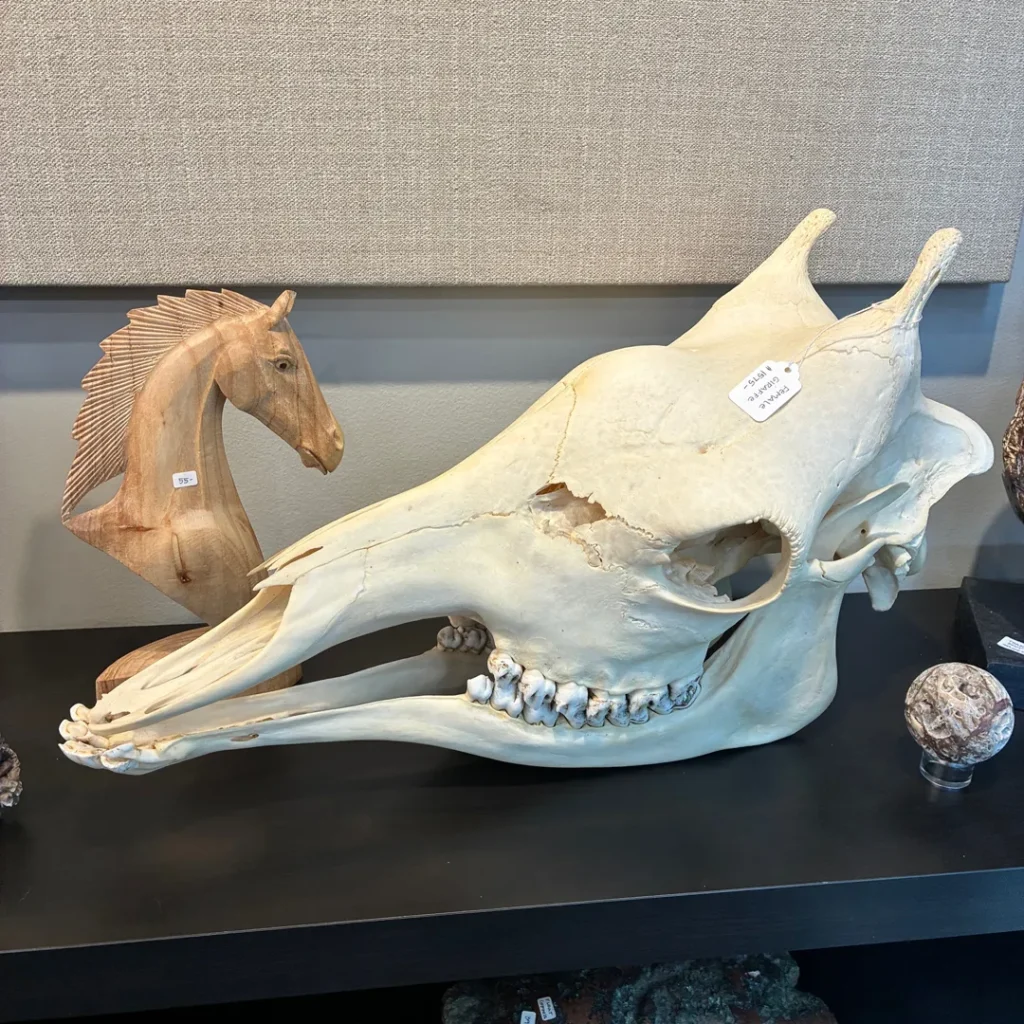
A giraffe skull looks like a long, narrow skull topped with two or more bony horn-like bumps, the ossicones. The face is elongated and tapers toward the front, the eye sockets are large and set high, and the lower jaw is long and slender.
The overall impression is of a big, elegant, slightly alien-looking skull. Unlike a deer or antelope skull, it has no true antlers or horns. Instead, those rounded knobs on top, the ossicones, are its signature feature, and they are covered in skin and hair in life rather than being bare bone or keratin.
Here is what stands out on a giraffe skull at a glance:
- Ossicones: two (sometimes three or five) bony bumps on top of the head
- A long, tapering face and elongated nasal region
- Large, high-set eye sockets giving wide, panoramic vision
- A long, slender lower jaw with a distinctive front tooth arrangement
- Considerable size and weight, especially in older males
What are the “horns” on a giraffe skull? Meet the ossicones.
The “horns” on a giraffe skull are not horns at all. They are ossicones, unique bony structures covered in skin and fur, and they are the single most interesting thing about the giraffe skull.
Ossicones form differently from horns and antlers. A deer grows and sheds antlers of bare bone each year. A cow or antelope has permanent horns of bone cored with a keratin sheath. A giraffe’s ossicones are neither. They start as cartilage, slowly turn to bone (ossify), and fuse to the skull, staying covered in skin and hair for life. This is why a giraffe skull has those rounded, knob-like projections rather than sharp points.
How many ossicones does a giraffe have?
Most people say two, but the real answer is more surprising: giraffes usually have at least two ossicones, and often three, or even five. Beyond the obvious pair on top, many giraffes have a third bump in the middle of the forehead (the median ossicone), which grows especially large in older males. Additional bony growths can form behind the main pair, giving some old bulls a lumpy, five-“horned” look.
This is a favorite piece of trivia, and it is exactly what makes the giraffe skull so distinctive. When you look at a skull, count the ossicones: their number and size tell you a lot about the animal’s age and sex.
Do male and female giraffe skulls differ?
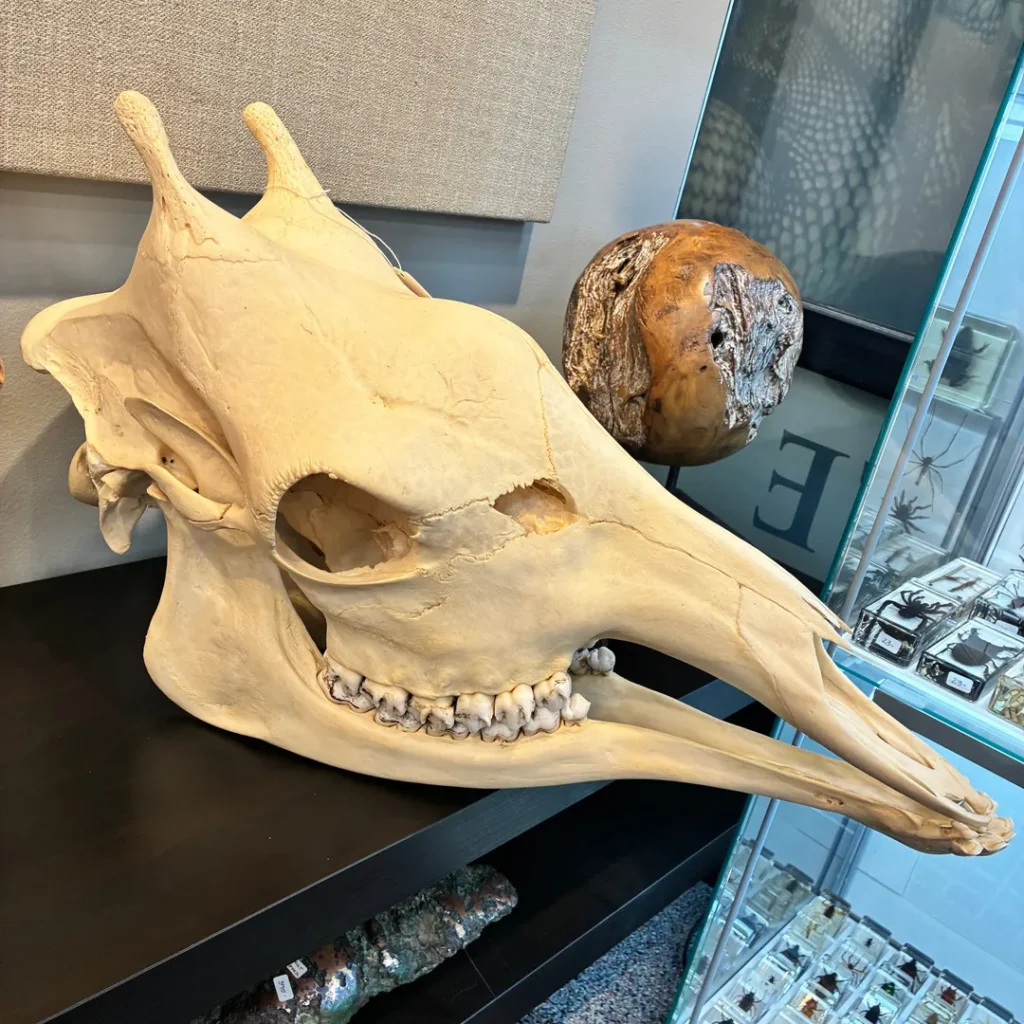
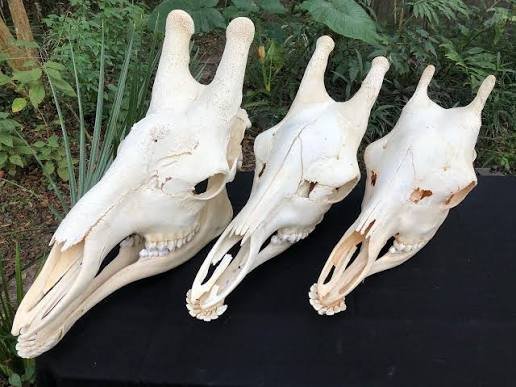
Yes, and the ossicones are the giveaway. Male giraffe skulls are larger and heavier and often show bald, worn ossicones from “necking,” the combat in which bulls swing their heads at each other. Older males also build up extra bone across the skull, making it thicker, lumpier, and much heavier.
Female giraffe skulls are lighter and more slender, with thinner ossicones that usually keep their tuft of hair on top. So if you are looking at a giraffe skull, its size, weight, and the state of the ossicones tell you whether it belonged to a male or a female.
Giraffe skull anatomy explained
Giraffe skull anatomy follows the same basic mammal plan as any other skull but is stretched and specialized for a browsing life at height. Understanding the parts helps you appreciate what you are looking at.
The skull divides, like all mammal skulls, into the cranium (the braincase, topped by the ossicones) and the facial skeleton (the long face and jaws). What makes the giraffe version special is the proportions: the face is greatly elongated, the nasal passages are long, and the whole structure is built light where it can be and strong where it must be, since it sits at the end of that famous neck.
Key anatomical features of the giraffe skull include:
- The ossicones, fused to the top of the cranium
- A long diastema, the gap between the front teeth and the cheek teeth, typical of grazing and browsing animals
- High-set orbits (eye sockets) for wide vision while browsing
- Air-filled sinuses that lighten the heavy skull
- A long, mobile tongue’s attachment area, reflecting the giraffe’s famous 45 cm tongue
For a broader look at how mammal skulls are built and compared, see our complete guide to animal skulls.
Giraffe skull teeth
Giraffe skull teeth surprise people: giraffes have no upper front teeth. Like cattle and deer, a giraffe has a tough pad on the roof of the front mouth instead of upper incisors, and the lower front teeth press against it to strip leaves.
Behind the front teeth sits the diastema, that toothless gap, and then the broad cheek teeth (molars and premolars) that grind up acacia leaves and twigs. A giraffe’s lower canine teeth are also unusual: they are lobed, almost split in two, which helps the animal comb leaves from thorny branches. In total a giraffe has 32 teeth, the same number as an adult human, arranged very differently.
How many bones are in a giraffe’s neck?
Here is the fact that stuns most people: a giraffe has just seven neck bones, the same number as you. Despite a neck that can reach two meters, a giraffe has only seven cervical vertebrae, exactly like humans and almost all mammals. Each one is simply enormous, up to 25 cm long.
This is why the giraffe skull sits where it does, balanced at the top of seven giant vertebrae rather than dozens of small ones. It is one of the most searched giraffe facts, and it connects directly to the skull: the base of the skull, where it meets that first massive vertebra, is heavily built to carry and move the head on the end of such a long lever. The junction of the skull and neck is a marvel of balance.
How big is a giraffe skull?
A giraffe skull is big: males average around 66 cm (26 inches) long, and females around 58 cm (23 inches). Including the ossicones, a male skull can stand over 45 cm (18 inches) tall. It is one of the larger land-mammal skulls you can own or study.
Here is a quick size reference:
| Measurement | Male giraffe skull | Female giraffe skull |
|---|---|---|
| Length | ~66 cm (26 in) | ~58 cm (23 in) |
| Width | ~33 cm (13 in) | ~25 cm (10 in) |
| Height (incl. ossicones) | ~46 cm (18 in) | ~39 cm (15.5 in) |
Weight varies a lot with age and sex. A female or young skull is relatively manageable, while an old bull’s skull, thickened with years of extra bone growth, can be strikingly heavy for its size. This heft is part of what collectors prize in a mature male specimen.
Why is the giraffe skull so specialized?
The giraffe skull is specialized because it sits at the top of a two-meter neck and has to do several demanding jobs at once. Everything about it is a trade-off between strength, weight, and function.
It has to be strong enough to survive “necking” combat and to anchor the powerful neck muscles, yet light enough not to overload that long neck. The solution is a skull that is dense and reinforced in the ossicone region but hollowed by air-filled sinuses elsewhere. The high-set eyes give a browsing giraffe a wide view to watch for predators while its head is buried in a tree. And the specialized teeth and long tongue let it feed where few other animals can reach. The skull, in short, is a piece of natural engineering for life at height.
How a giraffe skull grows and changes with age
A giraffe skull is not fixed; it changes dramatically over the animal’s life, and this is part of what makes each specimen unique. A young giraffe’s ossicones are not even attached at birth. They start as separate cartilage pads, lie flat to ease birth, then slowly ossify and fuse to the skull as the animal matures.
From there, the skull keeps building bone, especially in males. Older bulls deposit extra bone across the skull and ossicones year after year, a process called secondary ossification. This is why an old male’s skull is so much heavier, thicker, and lumpier than a young animal’s, and why the ossicones of an old bull are often bald and battered from combat. When you look at a giraffe skull, you are reading its life story: its age, its sex, and even its battles are written in the bone. This mirrors how age can be read from any skull, a principle we explore in our guide to the human skull.
Why does a giraffe skull look the way it does? A note on evolution
The giraffe skull is the product of a long evolutionary push toward feeding at height, and understanding that explains its every feature. As giraffe ancestors specialized in browsing the tops of trees that other animals could not reach, the neck lengthened and the skull adapted to match.
The face elongated to house the long feeding apparatus. The eyes moved high and to the sides for all-round vision while browsing. The ossicones evolved as combat and display tools for the “necking” battles between males, which is why they are so much heavier in bulls. And the whole skull balanced strength against weight to sit atop that famous neck. Every odd feature of the giraffe skull, once you know its story, turns out to be a neat solution to the challenge of living tall.
The giraffe skull compared to other animals
Placing a giraffe skull next to other skulls highlights just how unusual it is, which is why it is prized in comparative collections. Against a deer skull, the giraffe’s ossicones look nothing like branching antlers. Against an antelope or cow, there is no keratin horn sheath. The giraffe’s closest living relative, the okapi, shares the ossicones, though only males have them and they are smaller.
The giraffe skull is also a striking contrast to a human skull, sharing the same basic mammal blueprint but stretched almost beyond recognition. Comparing skulls like this is one of the joys of osteology, and it is why a giraffe skull makes such a powerful teaching and display piece. Explore more in our animal skulls guide and our guide to the human skull for the comparison.
Is it legal to own a giraffe skull?
In most places, yes, you can legally own a giraffe skull, but there is an important detail: giraffes are listed under CITES Appendix II, which regulates international trade in the species. This does not ban ownership, but it means a giraffe skull crossing borders should have the proper CITES documentation.
For you as a buyer, this means two things. First, buy from a dealer who sources legally and provides the correct paperwork. Second, be aware that international shipping of a giraffe skull may require CITES permits, which a responsible seller will handle or advise on. Owning a giraffe skull is entirely legitimate when it is sourced and documented properly, which is exactly how a reputable specialist operates.
Where to buy a real giraffe skull
If you want to own one, you can buy a real giraffe skull from a specialist osteology dealer who sources ethically and documents provenance and CITES compliance. A genuine giraffe skull is a large, dramatic, and increasingly sought-after specimen, whether for study, teaching, or display.
When buying, look for a dealer who tells you the specimen’s sex and approximate size, confirms it is legally and ethically sourced, provides CITES documentation where needed, and can ship it safely. These are large, fragile items that need proper freight packing. If a genuine skull is beyond your budget or your import rules are strict, a quality giraffe skull replica gives you the same striking display piece without the CITES considerations.
Browse our collection of real animal skulls and giraffe specimens at The Bones Vault, each ethically sourced, documented, and shipped worldwide in secure, insured packaging. Have a question about a specimen’s size, sex, or paperwork? Message us on WhatsApp before you buy; we will answer personally.
Real giraffe skull vs replica: which should you choose?
If you want a giraffe skull for display or study, you have two routes, and both are valid. A real giraffe skull offers genuine bone, natural detail, and the weight and presence that only the real thing has. A giraffe skull replica offers an accurate, lighter, more affordable cast with no CITES paperwork to worry about.
Here is how they compare:
| Factor | Real giraffe skull | Replica |
|---|---|---|
| Material | Genuine bone | Resin cast |
| Authenticity | Unique, natural variation | Accurate but identical each time |
| Price | Premium (hundreds to low thousands) | Much lower |
| CITES / paperwork | Needed for cross-border trade | None |
| Best for | Collectors, serious study, display | Budget display, teaching, easy shipping |
Choose a real skull if authenticity and presence matter most and you can meet the sourcing rules. Choose a replica if you want the drama at a lower price with simpler shipping. For more on accurate casts, see our guide to replica and model skulls.
The giraffe skull in art and design
Beyond biology, the giraffe skull has become a striking subject in art and decor, and it is easy to see why. Its elegant shape and unmistakable ossicones make it a favorite for drawing, sculpture, and photography, and “giraffe skull” is a popular art and tattoo motif.
Artists prize the giraffe skull for its clean lines and unusual silhouette, and it appears in everything from detailed anatomical studies to abstract line art and bold tattoo designs. Some designs even blend it with the Day of the Dead sugar-skull style, decorating the long face and ossicones with patterns and flowers. Whether rendered realistically or stylized, the giraffe skull carries the same appeal as any skull in art, a mix of natural beauty and quiet drama, with a shape that is entirely its own. Our guide to skull symbolism and meaning explores why skulls hold such a place in art and culture.
How to display a giraffe skull
A giraffe skull is a showpiece, and displaying it well makes the most of its drama. Because of its size, most collectors mount a giraffe skull on a wall or a sturdy stand where its height and ossicones can be appreciated. It becomes an instant focal point in a room, a study, or a cabinet of curiosities.
Keep it out of direct sunlight, which dries and yellows bone, and away from damp. Dust it gently and support its weight properly on display. Paired with other specimens, a giraffe skull anchors a natural-history collection like few other pieces. For ideas on building and styling a collection around a statement specimen, see our cabinet of curiosities guide.
Frequently asked questions
What are the horns on a giraffe skull called?
They are called ossicones. Unlike true horns or antlers, ossicones are bony structures covered in skin and hair. They start as cartilage, slowly turn to bone, and fuse to the top of the skull. Giraffes usually have at least two, and often three or five.
How many ossicones does a giraffe have?
Usually at least two, but often three or even five. Beyond the main pair, many giraffes have a median bump on the forehead, and older males can develop extra bony growths, giving some bulls a five-“horned” appearance.
How big is a giraffe skull?
A male giraffe skull averages about 66 cm (26 inches) long and a female about 58 cm (23 inches). Including the ossicones, a male skull can be over 45 cm (18 inches) tall, making it one of the larger land-mammal skulls.
Do giraffes have teeth?
Yes, giraffes have 32 teeth, but no upper front teeth. Instead, they have a tough dental pad that the lower incisors press against to strip leaves. Their lobed lower canines help comb foliage from thorny branches.
Do male and female giraffe skulls look different?
Yes. Male skulls are larger and heavier and often have bald, worn ossicones from combat, plus extra bone build-up with age. Female skulls are lighter and more slender, with thinner ossicones that usually keep a tuft of hair.
Is it legal to own a giraffe skull?
In most places, yes, but giraffes are listed under CITES Appendix II, so a skull crossing borders needs proper CITES documentation. Buy from a dealer who sources legally and provides the correct paperwork.
How much does a real giraffe skull cost?
Genuine giraffe skulls are premium specimens, typically costing well into the hundreds or low thousands depending on sex, size, condition, and provenance. Larger, heavier male skulls command the most. Replicas cost considerably less.
What is the closest animal to a giraffe skull?
The okapi, the giraffe’s only living relative, has the most similar skull, including ossicones (in males). Deer, antelope, and cattle skulls look superficially similar but have antlers or keratin horns rather than ossicones.
The most fascinating skull on the savanna
The giraffe skull is one of the most distinctive in the animal kingdom: those skin-covered ossicones, the toothless upper front jaw, and the elongated face built for life at height. Now you know what it looks like, why it has “horns,” how big it gets, and how to own one.
Ready to add this showpiece to your collection? Browse our ethically sourced animal skulls and specimens, explore our complete animal skulls guide, or see how to style a statement piece in our cabinet of curiosities guide. Every specimen is documented, CITES-compliant where required, and ships worldwide in secure, insured packaging. Questions? Message us on WhatsApp or contact us via email; we are here to help.