
The Elephant Skull: The Cyclops Myth, Tusks, and Anatomy Explained
An elephant skull is a massive, dome-shaped skull with a single large hole in the center of the face, and that hole is exactly why ancient Greeks may have believed in one-eyed Cyclops giants. The “eye socket” is not an eye socket at all: it is the nasal opening where the trunk attached. This guide explains everything about the elephant skull, from that famous cyclops story to its tusks, teeth, size, and anatomy.
You will learn what an elephant skull looks like, why it is so big yet so light, how the tusks and teeth work, the difference between African and Asian skulls, and how to buy a real one. Whether you are here out of curiosity, for study, or to start a collection, you will get the full picture. Let’s dig in.
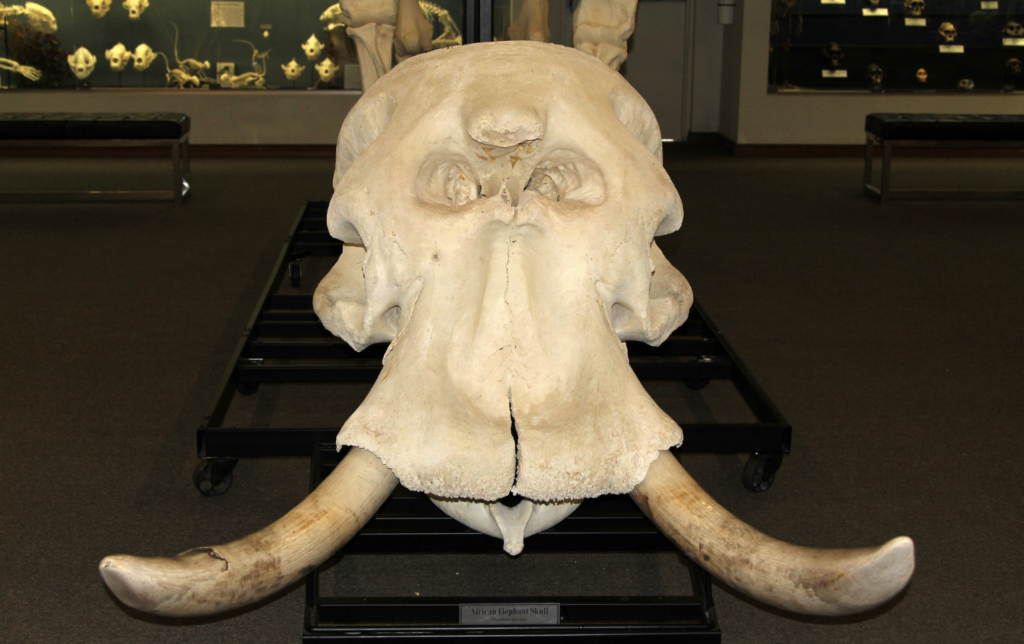
What does an elephant skull look like?
An elephant skull looks like a huge, rounded, honeycombed dome with a large central hole where the trunk once attached, tusk sockets at the front, and surprisingly small brain space for its size. It is one of the most distinctive and misread skulls in the animal kingdom.
The first thing people notice is that big central opening, which looks exactly like a single giant eye socket. It is not. It is the nasal cavity, the anchor point for the trunk. The real eye sockets sit lower and to the sides, smaller and easy to miss. Add the long tusk sockets jutting from the front and the vast, air-filled dome on top, and you have a skull unlike any other.
Here is what stands out on an elephant skull at a glance:
- A large central hole (the nasal opening, not an eye) that inspired the cyclops myth
- Tusk sockets at the front, holding the long ivory tusks
- A huge, domed cranium that is mostly air-filled honeycomb bone
- Small actual eye sockets, set low and to the sides
- Massive grinding teeth deep in the jaws
Why does an elephant skull look like a cyclops?
An elephant skull looks like a cyclops because of the single large hole in the middle of its face, the nasal opening for the trunk, which looks just like one enormous central eye socket. Ancient people who found elephant skulls, without ever having seen a living elephant, may have imagined a one-eyed giant.
This is one of the most fascinating stories in natural history. On islands like Sicily and Cyprus, ancient Greeks dug up the skulls of extinct dwarf elephants. They had no idea what these animals were. Faced with a skull twice the size of a human head, with a gaping “eye” in the center, the natural conclusion was a race of one-eyed giants: the Cyclopes of Greek mythology.
Many historians and paleontologists find this explanation compelling, and it is widely cited as a likely origin of the cyclops legend. Whether or not it is the whole story, the resemblance is undeniable. Hold an elephant skull front-on, and the single “eye” stares right back at you. It is the perfect example of how fossils and bones shaped ancient myths.
The dwarf elephants behind the myth
The skulls that most likely started the cyclops legend belonged to dwarf elephants, and their story is remarkable in its own right. On Mediterranean islands like Sicily, Malta, Cyprus, and Crete, elephants that became stranded evolved into miniature forms over thousands of years, a process called island dwarfism.
Some of these dwarf elephants stood barely a meter tall, with skulls not much bigger than a human head, yet keeping that unmistakable central “eye” hole. When ancient people unearthed them, they found a skull that was human-sized but monstrous-looking, with one giant socket in the middle. It is easy to see how the idea of a one-eyed giant took hold. These same dwarf elephant skulls are a sought-after subject for collectors and a genuine link between palaeontology and mythology. The “dwarf elephant skull” and “pygmy elephant skull” are searched by people chasing exactly this story.
Where are an elephant’s real eyes?
An elephant’s real eye sockets sit lower and to the sides of the skull, well away from that central hole. They are relatively small, which is why they are easy to overlook and why the big nasal opening steals all the attention. So the “cyclops eye” is really the nose, and the real eyes hide in plain sight on either side.
The nasal opening and the trunk
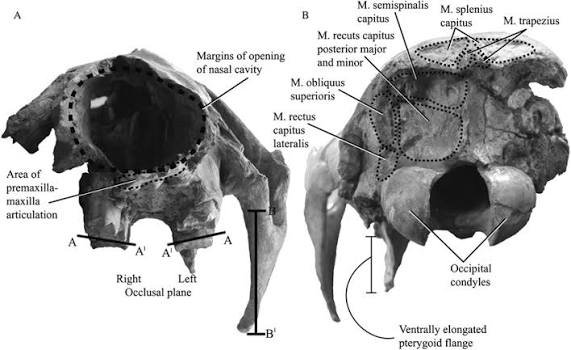
That central hole does one of the most important jobs in the animal kingdom: it anchors the trunk. The trunk is a fusion of the nose and upper lip, containing no bone at all, just muscle, so the skull only shows where it attached, not the trunk itself.
The large nasal opening and the chambers around it supported the powerful muscles that make the trunk so strong and dexterous. This is why the hole is so big: it had to anchor an organ capable of lifting logs and picking up a single blade of grass. When you understand that the “eye” is really the root of the trunk, the whole skull suddenly makes sense.
Elephant skull anatomy: built big but light
Elephant skull anatomy solves a tricky problem: how do you build a skull big enough to anchor tusks, a trunk, and huge chewing muscles without it being too heavy to lift? The answer is a honeycomb.
The huge domed cranium is not solid bone. It is filled with air cells, a honeycomb of sinuses that make the skull light for its size while keeping it strong and large enough for all those muscle attachments. Inside this vast structure, the actual brain cavity is relatively small. So the elephant’s famously large brain sits within a skull that is mostly air.
Key features of elephant skull anatomy include:
- Air-filled sinuses (the honeycomb) that lighten the massive skull
- A relatively small brain cavity despite the skull’s size
- Deep tusk sockets (alveoli) at the front of the upper jaw
- Large chewing surfaces for the grinding molars
- Strong muscle attachments for the trunk, jaw, and neck
For a broader look at how mammal skulls compare, see our complete guide to animal skulls.
Elephant tusks: giant teeth, not horns
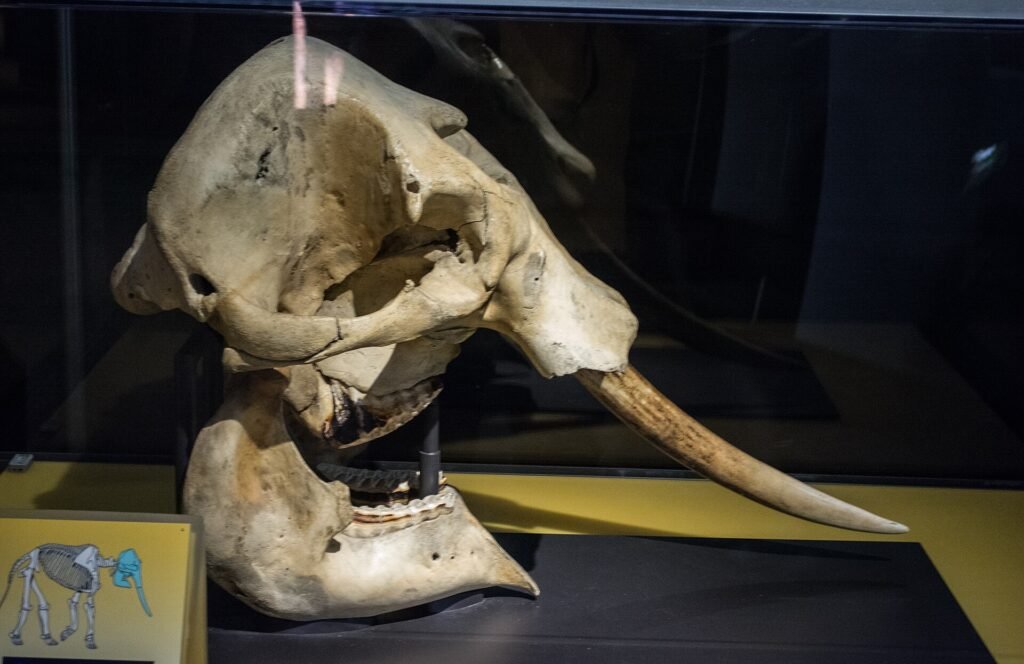
An elephant’s tusks are teeth, specifically massively elongated upper incisors, not horns. They grow from deep sockets in the front of the skull and keep growing throughout the elephant’s life. This is one of the most important things to understand about the elephant skull.
Because tusks are teeth, they are made of dentine, capped with enamel when they first erupt, and they carry a pulp cavity and nerve like any tooth. About a third of each tusk is hidden inside the socket in the skull. This is why an elephant skull has those long, deep channels at the front; they held the roots of the tusks. Both African elephant sexes usually have tusks, while in Asian elephants, prominent tusks are mainly a feature of males.
Elephant skull with tusks: what to know
A genuine elephant skull with tusks is a rare and heavily regulated specimen, because ivory is strictly controlled under international law. Most elephant skulls sold today are either replicas or genuine skulls without the tusks or antique specimens with full documentation. If a skull includes real ivory tusks, it must comply with strict CITES and national ivory rules, which we cover below.
Elephant teeth: nature’s conveyor belt
Beyond the tusks, elephant teeth are astonishing, and the skull reveals how they work. An elephant has just a few enormous grinding molars in use at any time, and it replaces them in a slow conveyor-belt system throughout its life.
Instead of growing adult teeth that last, an elephant grows six sets of massive molars, one after another. As the front molar wears down from grinding tough vegetation, it falls out, and a new one pushes forward from behind to replace it. An elephant goes through this process about six times in its life. When the final set wears out in old age, the animal can no longer feed properly, which is often what limits an elephant’s natural lifespan. The skull and jaws are built around these giant, ridged grinding teeth.
How big is an elephant skull?
An elephant skull is big and heavy: an adult African elephant skull can measure around 90 cm to 100 cm (35 to 39 inches) long and weigh a great deal even without the tusks, thanks to its sheer size. It is one of the largest land-mammal skulls you can study or own.
Here is a rough size guide:
| Measurement | African elephant skull | Asian elephant skull |
|---|---|---|
| Length | ~90-100 cm (35-39 in) | ~85-95 cm (33-37 in) |
| Shape | Broader, single-domed forehead | Twin-domed forehead (“bumps”) |
| Tusks | Usually both sexes | Mainly males |
Despite the honeycomb construction that lightens it, an elephant skull is still a substantial, heavy object, and a real one makes a commanding display or study piece. The dwarf elephant skulls that inspired the cyclops myth were much smaller, closer to the size of a large human head, which is part of why they fooled the ancient Greeks.
African vs. Asian elephant skull
African and Asian elephant skulls differ in ways you can spot once you know what to look for, and telling them apart is a favorite question among collectors. The clearest difference is the forehead.
An African elephant skull has a single, rounded dome on top and is generally larger, with bigger tusk sockets since both sexes carry prominent tusks. An Asian elephant skull has a distinctive twin-domed forehead, two bumps with a dip between them, and smaller tusk sockets, since mainly males have large tusks. Asian skulls are also slightly smaller on average. These differences reflect the two species’ separate evolution and are reliable identifiers on a real specimen.
Elephant skull vs. mammoth and mastodon
Because elephants have famous extinct relatives, people often want to know how an elephant skull compares to a mammoth or mastodon, and the differences are genuinely interesting. All three are proboscideans, sharing the trunk anchor and tusk sockets, but each skull has its own signature.
A mammoth skull is tall and domed, even more so than an elephant’s, with a high peak and long, dramatically curved tusks. A mastodon skull is flatter and longer, with straighter tusks and, crucially, very different teeth: mastodons had pointed, cusped molars for browsing, while elephants and mammoths have flat, ridged grinding molars. The modern elephant skull sits alongside these as the last survivor of a once-vast family. If you are interested in the ivory of these relatives, our guide on whether mammoth ivory is legal explains how extinct-species ivory differs from elephant ivory in law.
Real elephant skull vs. replica: which should you choose?
If you want an elephant skull for display or study, you have two routes, and the ivory rules make this choice more important than for most skulls. A real elephant skull offers genuine bone and presence; a replica offers the full size and drama with no ivory regulations and a much lower price.
Here is how they compare:
| Factor | Real elephant skull | Replica |
|---|---|---|
| Material | Genuine bone | Resin cast |
| Size and look | Authentic, full-scale | Accurate, full-scale |
| Price | Premium (often thousands) | Lower |
| Ivory / CITES | Strict, especially with tusks | None |
| Best for | Serious collectors, study | Display, teaching, easy shipping |
Choose a real skull if authenticity matters most and you can meet the sourcing and ivory rules, ideally a documented, tusk-free specimen. Choose a replica if you want the size and the cyclops look without the legal complexity. For more on accurate casts, see our guide to replica and model skulls.
Is it legal to own an elephant skull?
Owning an elephant skull is legal in many places, but it is heavily regulated, and the tusks are the key issue. Elephants are protected under CITES, and elephant ivory is banned or tightly restricted in most countries, so a skull with real tusks faces serious legal limits.
Here is the practical position. A genuine elephant skull without ivory, or a replica, is far simpler to own and trade. A skull with real tusks is subject to strict CITES rules and national ivory bans and, in many countries, cannot be sold at all. Laws vary widely by country and even by state, so you must confirm your local rules before buying. A reputable dealer sells only lawfully sourced specimens, provides documentation, and will not ship where it is illegal. When in doubt, a replica or a tusk-free specimen avoids the ivory problem entirely.
Where to buy a real elephant skull
You can buy a real elephant skull from a specialist osteology dealer who sources legally and documents provenance and CITES compliance. Because of the ivory rules, most elephant skulls on the market are replicas or genuine tusk-free specimens, both of which make superb display and study pieces.
When buying, choose a dealer who states clearly whether a specimen is real or a replica, African or Asian, confirms it is legally and ethically sourced, provides CITES paperwork where relevant, and can ship a large, heavy item safely. If you want the drama of an elephant skull without the cost or the ivory regulations, a quality replica is the smart choice; it captures the size and the famous cyclops look at a fraction of the price.
Browse our collection of ethically sourced skulls and specimens at The Bones Vault, each documented and shipped worldwide in secure, insured packaging. Have a question about a specimen’s origin, species, or paperwork? Message us on WhatsApp before you buy; we will answer personally.
Why the elephant skull evolved this way
Every strange feature of the elephant skull is a solution to the challenge of being enormous, and understanding that makes the whole thing click. The skull had to support a trunk, anchor ever-growing tusks, power the grinding of tough vegetation, and carry a large brain, all without becoming so heavy the animal could not lift its head.
The honeycomb of air cells is the master stroke: it lets the skull grow huge to provide surface area for muscle attachment while staying as light as possible. The forward-set nasal opening evolved as the trunk became the elephant’s primary tool for feeding, drinking, and sensing the world. The tusks grew from incisors into multipurpose tools and weapons. And the conveyor-belt molars evolved to survive a lifetime of grinding abrasive plants. The elephant skull is what happens when evolution builds a giant, intelligent, tool-using herbivore, and it is why no other skull looks quite like it.
The elephant skull in myth, art, and culture
Few skulls carry as much cultural weight as the elephant skull, and that is part of its appeal as a collector’s piece. Its starring role in the cyclops myth alone makes it one of the most storied objects in natural history, a real skull that shaped an entire legend.
Beyond the cyclops, the elephant skull appears in art, tattoo design, and decor, prized for its dramatic shape and powerful symbolism of memory, wisdom, and strength. “Elephant skull” is a popular tattoo and drawing subject, often stylized or blended with mandala and sugar-skull designs. Whether as a scientific specimen, a myth-making marvel, or a striking piece of decor, the elephant skull earns its place in any serious collection. For more on why skulls hold such meaning, see our guide to skull symbolism and meaning.
How to display an elephant skull
An elephant skull is a statement piece, and displaying it well makes the most of its size and story. Because it is large and heavy, most collectors give it pride of place on a strong stand or a dedicated surface where its scale and that famous central “eye” can be seen front-on, the angle that shows off the cyclops resemblance.
Keep it out of direct sunlight, which dries and yellows bone, and away from damp. Support its considerable weight properly and dust it gently. As the centrepiece of a natural history collection or cabinet of curiosities, few specimens command a room like an elephant skull. For ideas on building a collection around a statement piece, see our cabinet of curiosities guide.
Frequently asked questions
Why does an elephant skull look like a cyclops?
Because of the single large hole in the center of its face. That hole is the nasal opening where the trunk attached, but it looks exactly like one giant eye socket. Ancient Greeks who found dwarf elephant skulls, never having seen a living elephant, may have imagined one-eyed giants, the Cyclopes.
Is the hole in an elephant skull an eye socket?
No. The large central hole is the nasal opening, the anchor point for the trunk. The real eye sockets are smaller and sit lower and to the sides of the skull.
Are elephant tusks teeth or horns?
Tusks are teeth, specifically massively elongated upper incisors made of dentine. They grow from deep sockets in the skull and keep growing throughout the elephant’s life. They are not horns.
How big is an elephant skull?
An adult African elephant skull is around 90 to 100 cm (35 to 39 inches) long and heavy despite its air-filled, honeycomb construction. It is one of the largest land-mammal skulls.
What is the difference between African and Asian elephant skulls?
An African elephant skull has a single rounded dome on top and is generally larger, with both sexes usually carrying tusks. An Asian elephant skull has a twin-domed forehead (two bumps) and is slightly smaller, with prominent tusks mainly in males.
Why is an elephant skull so big but light?
The huge domed cranium is filled with air cells, a honeycomb of sinuses, rather than solid bone. This keeps the skull light enough to carry while providing the large surface area needed to anchor the trunk, tusks, and chewing muscles.
Is it legal to own an elephant skull?
Owning one is legal in many places, but it is heavily regulated, and the tusks are the issue. Elephant ivory is banned or restricted in most countries, so a skull with real tusks faces strict CITES and national limits. A tusk-free specimen or a replica is far simpler to own.
How much does an elephant skull cost?
Genuine specimens and quality replicas are premium items, often costing well into the thousands (the Skulls Unlimited replica alone is around $2,600). Price depends on whether it is real or a replica, its size, condition, and documentation.
The most misunderstood skull in nature
The elephant skull is a masterpiece of natural engineering and a genuine piece of mythology: that single central “eye” that launched the cyclops legend, the tusks that are really teeth, and the honeycomb dome that is big yet light. Now you know what you are really looking at.
Ready to own this remarkable piece? Browse our ethically sourced skulls and specimens, explore our complete animal skulls guide, or see how to style a statement piece in our cabinet of curiosities guide. Every specimen is documented, CITES-compliant where required, and ships worldwide in secure, insured packaging. Questions? Message us on WhatsApp or contact us via email. We are here to help.